We’re not entirely sure what toilet paper has to do with tobacco, but a British TV commercial that aired about twenty-five years ago made the connection — and apparently, it worked. The ad was so memorable that it was voted the 8th greatest television advertisement of all time when Channel 4, in collaboration with The Sunday Times, produced its special, “The 100 Greatest TV Ads.” Check it out:
Since it used a purebred dog in a positive light, we’re good with it, but the advertising honeymoon ended when all tobacco advertising on television was banned in the UK in 1991. Hamlet cigars shifted their marketing efforts to cinemas in 1992 where tobacco advertising was still permitted, and the Hamlet campaign continued to run until 1999. The final Hamlet commercial, created as a farewell to the long-running campaign, used a new tagline: “Happiness will always be a cigar called Hamlet,” a closing line meant as a swan song to one of Britain’s most beloved advertising series.
By now, you might be wondering where we’re going with this. Cigars make us think of tobacco, and tobacco makes us think of the Havanese. Why? Because of the color called, “tobacco,” and its place (or lack thereof ) in major breed registries.
To our knowledge, AKC registration has the most color choices for Havanese of any registry, but it does not include “tobacco” as an option while the FCI specifically does (from the FCI: Colour: Rarely completely pure white, fawn in its different shades (slight blackened overlay admitted), black, havana-brown, tobacco colour, reddish-brown). This isn’t to say the color isn’t accepted by the AKC (or the United Kennel Club) since both essentially say that all colors and marking patterns are permissible and of equal merit.
This is saying something because with over twenty standard colors, seven alternate colors, and eight standard patterns, that’s around 243 possible combinations.
But…..
it is the national breed club that determines which colors appear on AKC forms, not the AKC itself. To our knowledge (and we stand corrected if we find evidence to the contrary), the Havanese Club of America recognized that a “reasonable palette to cover most probabilities” was needed for practical registration purposes, and tobacco wasn’t included in this palette, in part because it’s genetically unclear—scientists haven’t definitively identified what produces the coloration.
Tobacco’s exclusion also reflects a practical challenge. Most Havanese who grow up to be tobacco brown appear nearly black at 8-16 weeks when puppies are registered. The color develops distinctly during the first two years, making early registration difficult since breeders must predict adult coloration. They have, however, a workaround. The most straightforward is to register the youngster as “black” or “black brindle,” since tobacco Havanese do have black pigmentation, so this is functionally accurate and widely accepted. Alternatively, breeders can also select the “Other” option, writing in the color choice and three-digit code, optionally submitting a photograph.
So at the end of the day, the color, “tobacco,” isn’t excluded because it’s unacceptable; it’s excluded because a finite palette was chosen for practical purposes. The color remains fully acceptable, registrable, and suitable for competition, reflecting how breed clubs balance breed standard flexibility with registration system practicality.
In looking for photos of a “tobacco” colored dog, we came across dogs whose colors were described as “havana-brown,” and wondered if they were the same thing since the FCI breed standard specifically lists both “Havana-brown” and “Tobacco color” as separate acceptable colors. Again, we defer to breed experts, but as far as we can tell, the primary difference is pigmentation – brown pigment for Havana, black pigment for Tobacco.
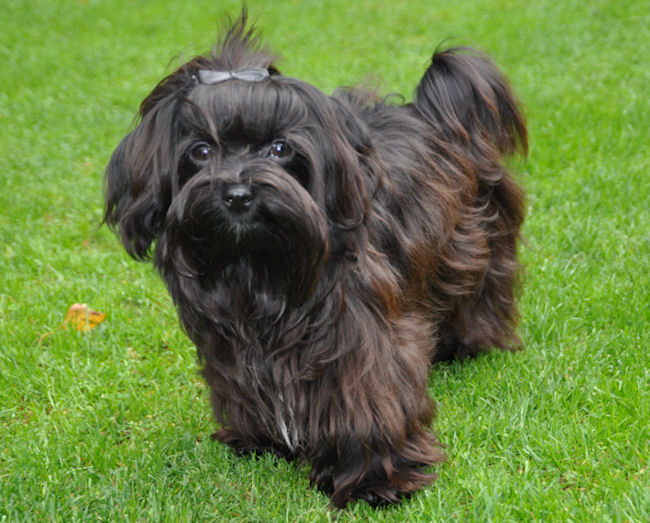
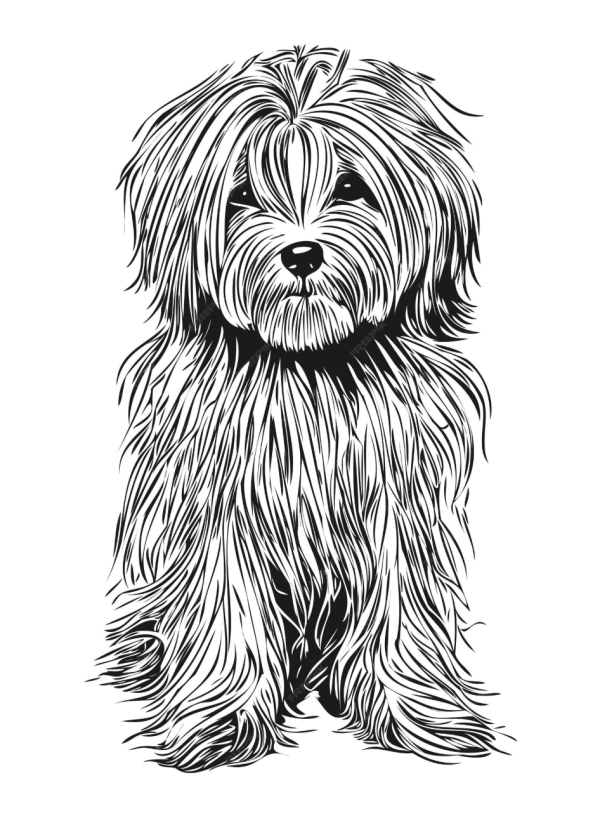
Image: A hand drawn line art vector drawing of a Havanese by TarickSS