
The origin of the Clumber Spaniel is shrouded in a mix of tradition, repetition, and educated guesswork rather than firm documentation. Sporting writer William Barker Daniel, in his multivolume Rural Sports (early 19th century), helped popularize the oft‑repeated story that the Duke of Noailles of France sent his Spaniels to England for safekeeping during the French Revolution. According to this account, the dogs were received by Henry Fiennes Pelham‑Clinton, 2nd Duke of Newcastle, and kept at his Nottinghamshire estate, Clumber Park, from which the breed takes its name. While enduringly appealing, no contemporary records are known to substantiate this French transfer tale in either the Newcastle or Noailles family archives, so it remains an elegant but unproven origin myth rather than settled fact.
What we can say with more confidence is that the Newcastles kept their own distinct working Spaniels at Clumber well before the rise of formal dog shows. Estate records refer to these dogs as “the Duke’s breed” or “Mansell’s breed,” suggesting a recognizable local type shaped for the heavy cover and demanding shooting conditions of the park. Various authors have speculated that these native working Spaniels were crossed with heavier dogs to produce a more substantial, low‑stationed animal able to force its way through dense undergrowth. The now‑extinct Alpine Spaniel is sometimes proposed as a contributor, and another long‑standing theory holds that Basset Hound blood may have played a part. Both ideas remain conjectural, however, and they are best treated as plausible attempts to explain the Clumber’s phenotype rather than as documented breeding steps.
Clumber‑type Spaniels were not unique to the Newcastle estate. Other great families in the region, including the Duke of Portland, Earl Spencer, and George Foljambe of Osberton, maintained similar dogs to work comparable cover. Foljambe is known to have supplied dogs back into the Newcastle kennel, reinforcing the notion of a shared local working strain rather than a single, closed founding line. By the time organized dog shows emerged, Earl Spencer was among the earliest exhibitors of what would be recognized as the Clumber Spaniel, helping move the breed from private shooting box to public bench.
Royal patronage would later cement the Clumber’s image as an aristocrat among gundogs. The strongest and best‑documented association is with King Edward VII at Sandringham, where Clumbers were run in purposeful, low‑key packs—often half a dozen or so dogs—behind substantial teams of beaters. They were valued for the same qualities many gundog people still prize today: a steady, thorough, close‑working style, the power to handle punishing cover, and a quiet, businesslike attitude that made them as dependable in the field as they were distinctive on the lawn.
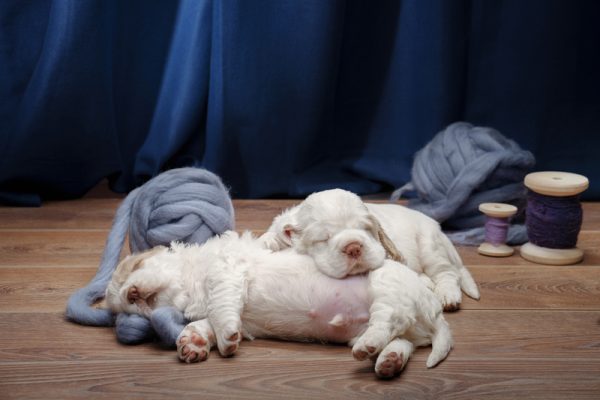
And because few of us get to see Clumber Spaniel puppies this young, voila! Photo by Annaav/Dreamstime