
Years ago at a dog show, spectators wandered through the grooming area, mesmerized by the rich variety of breeds. A young couple stopped a few feet away from the setups of two different exhibitors, each grooming their own dog at separate grooming tables—one with a Belgian Sheepdog, the other with a Schipperke. The couple looked at the Schipperke, then at the Belgian Sheepdog. Back and forth. We could guess what they were thinking. Not wanting to offend the owner of either dog, they approached us and asked if one was the parent of the other. We were happy to explain that they were two different breeds, and when they left, the Schippie owner, brushing her dog, said, “We get that a lot.”

The couple’s cursory glance provided them more similarities than differences: both dogs were black and had similar ear, muzzle, and head shapes. Had the couple investigated a bit more, they would have seen what is obvious to dog folk: these are markedly different breeds with unique characteristics.
The anecdote is a reminder that, in the world of purebred dogs, similarities are deceiving, and the person who makes casual observations does so at their peril. Several breeds can invite confusion if one only goes by superficial similarities: The Old English Sheepdog and Bearded Collie, the Whippet and Italian Greyhound, the Alaskan Malamute and Siberian Husky—and many more!
In this post, we touch upon two Japanese breeds that can also cause confusion at first glance: The Shiba Inu and Shikoku. To the uneducated, they might look like different sized varieties of the same breed. They are not! And it must be a common error because dozens of web pages and articles specifically address the differences between the two, including major pet information sites, breed-specific blogs, and online forums. Because we think a picture really is worth a thousand words, we weigh in on the topic by sharing an image of a Shiba Inu sitting next to a Shikoku:
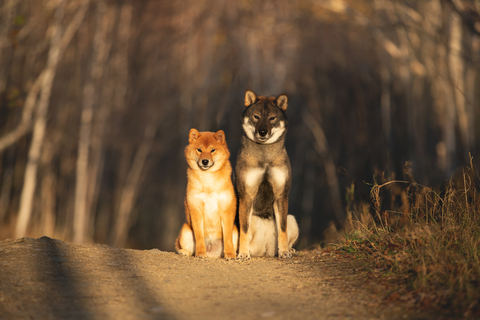
At first blush, both breeds share a spitz-type appearance, curled tail, and Japanese heritage, but the photo by Anastasiia Cherniavskaia vividly illustrates that the Shiba Inu (at the left) is significantly smaller (in fact, the Shiba is the smallest of Japan’s native breeds). On average, Shibas stand 13.5 to 16.5 inches tall and weigh 17 to 23 pounds as compared to the Shikoku which can be 19 to 20.5 inches tall and weigh 35 to 55 pounds.
Beyond size, the Shiba Inu has a compact, well-muscled frame with a fox-like face, small upright ears, and a thick double coat that comes in red, sesame, or black and tan, always with distinct cream to white “urajiro” markings on the cheeks, chest, and underside. The Shikoku, by contrast, is more robust and athletic, with a slightly longer body, a wedge-shaped head, and larger, more pronounced triangular ears. Its coat is also double but harsher in texture, and it is found in a wider range of sesame shades—red sesame, black sesame, and black and tan—each with the required urajiro markings. The Shikoku’s tail is typically carried in a sickle or curled position, similar to the Shiba, but is often bushier and set higher. Overall, the Shikoku’s physical presence is more substantial and rugged, reflecting its origins as a hunter of large game, while the Shiba Inu’s features are more delicate and refined, suited to its role as a small game hunter and companion.
Not the same at all! And those are just the physical traits.
The Shiba Inu is spirited, independent —- often described as “cat-like”—loyal to family but aloof with strangers, with a stubborn streak. In contrast, the Shikoku is energetic, handler-focused, and perhaps more eager to please, yet still reserved and selective in its social interactions. Both breeds are intelligent and alert, and for the owner who did their homework, each is the perfect breed.
If the “devil is in the details,” then in the dog world, it is those details that make the breed.
Images: Shikoku by Miraswonderland/Depositphotos; Shiba Inu by MolikaAn/Depositphotos