On these pages, we aim to educate, entertain, and persuade readers that purebred dogs are worthy of protection and preservation.
Our readers are the threads in a rich tapestry of owners, show judges, trainers, groomers, and fanciers (typically fans, breeders, or exhibitors who show their dogs as a vocational hobby rather than for profit). Keeping the interest of such a diverse audience can be a daily challenge.
If you are here, we believe you’re interested in all things related to dog breeds—from structure and standards to trivia and fun facts. To that end, we refuse to talk down to our audience. We learned long ago that dog people are endlessly curious, and we hope our posts always “scratch that itch.”
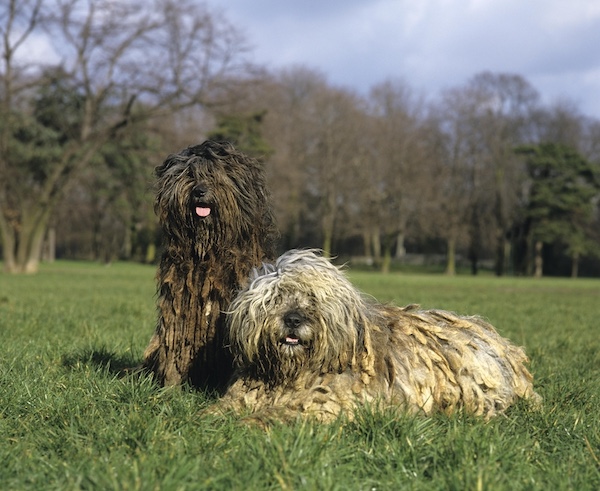
That being said (and out of our system), we turn to a breed that, to the casual observer, is all about the coat. The Bergamasco is covered with an abundant coat made up of three types of hair that form “flocks” (not cords). In this post, however, we are going to touch upon something easily overlooked in such a coated breed: the dog’s ears.
Yes, they have ears. Two per dog.
And unless someone evaluating a Bergamasco uses their hands to feel the dog, they will never be able to assess a proper ear in the dog.
With one’s hands stuffed in one’s pockets, one might be able to ascertain whether the ears are set on high (they should be). Seen from the side, the ears seem to be an extension of the curve of the back of the neck. But in our view, that’s about all that can be gleaned without a hands-on examination.
The ears should be soft and thin. For this, one needs to feel with one’s hands. The ear length should not exceed half the length of the head, and while shorter is preferred, neither can be determined without using one’s hands to dig through the flocks and feel the ears. The same applies to determining if, at their widest points, the ears are 2½ to 3 inches wide. Also, the top two-thirds of the ear is triangular in shape with slightly rounded tips. However, since the ears fall in with the flocks, and flocks may be longer than the ear itself, physical perusal is necessary.
The combination of the ear’s softness, high set, and integration with the flocked coat is rare among herding breeds, many of which may have pendant or semi-erect ears. But note, every aspect of the Bergamasco’s ear structure has a purpose specifically adapted to both its mountainous working environment. Flocked/matted/felted hair on the Bergamasco’s ears forms a thick, textured layer that acts as a natural shield, a barrier against dirt, dust, seeds, and other vegetation. It also offers excellent insulation during frigid temperatures by helping retain body heat and shielding sensitive ear tissue from harsh winds, rain, and snow. This is especially important for a breed that worked in the Italian Alps.
The texture of the flocked hair, combined with the oily undercoat, creates a water-resistant barrier that helps keep the inner ear dry and reduces the risk of moisture-related ear infections. The hair on the ears also can act as a form of defense, if you will, when the dog has to push through vegetation, or if attacked by a predator interested in the livestock. Some even believe that flocked ears that blend with the rest of the coat help make the dog less conspicuous to predators when working among sheep or in rugged terrain – a natural camouflage.
As children, we’re told to “look, don’t touch.” This is the worst possible advice to anyone who is going to evaluate the Bergamasco – or any corded or heavy coated breed, for that matter.
Image of Bergamasco by ©Slowmotiongli/Dreamstime.com