
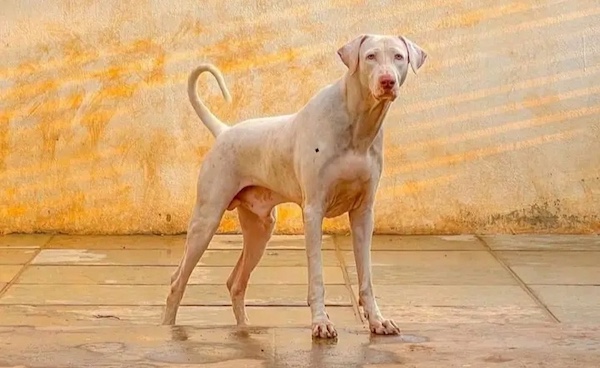
In light of that, it’s encouraging to see that an article in Moneycontrol (of all places) reports state police, military, and paramilitary forces—including the Indian Army—are increasingly turning to (or rediscovering?) indigenous dog breeds, and in this case, for critical security operations. One of the breeds involved is the Rajapalayam. Originating from the town of Rajapalayam in Tamil Nadu, this ancient sighthound is now being rediscovered by law enforcement for its exceptional qualities in security roles. What qualities set it apart? Fearlessness, natural guarding instincts, and adaptability to hot climates—traits that make the Rajapalayam particularly suitable for security deployments in southern India.
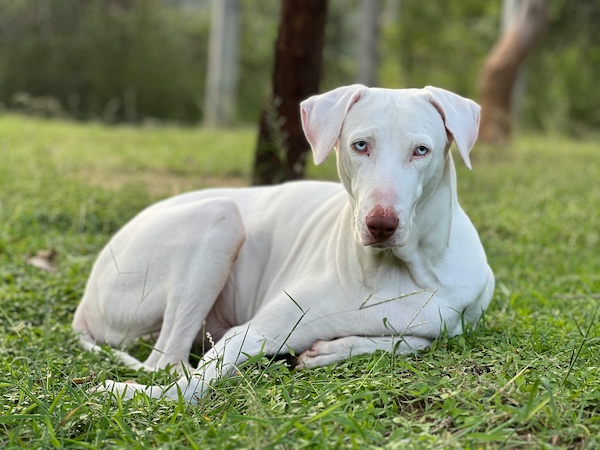
Photo of Rajapalayam by Sanjay Bolade
With a history tied to the 18th-century Nayak dynasty, these handsome white dogs were once cherished by royalty for hunting wild boar and guarding estates. Their modern use in law enforcement, especially in southern India and border regions like Jammu and Kashmir, aligns with India’s “Vocal for Local” initiative, which promotes native breeds and has received support from Prime Minister Narendra Modi, as mentioned in Mann Ki Baat (India Today).
Standing 25–30 inches tall, the Rajapalayam’s muscular build, deep chest, and racehorse gait are ideal for speed and endurance. Its white coat, often accompanied by a pink nose and golden eyes, is well-suited to India’s hot climate, reducing health issues compared to imported breeds. Rajapalayams are loyal, intelligent, have a high prey drive and wariness of strangers, and excel in tracking, patrolling, and threat detection. However, their touch sensitivity and independent streak require early socialization to manage aggression, according to Dr. K. Vairavasamy, former Dean of the Veterinary College and Research Institute in Tirunelveli, Tamil Nadu.
Breeding for law enforcement is primarily managed by dedicated local breeders in Tamil Nadu, who often collaborate with government agencies to maintain the breed’s health, temperament, and distinctive type. Training, which relies on positive reinforcement, spans several months and focuses on obedience, scent detection, narcotics and explosives identification, and patrol techniques.
The Rajapalayam’s resurgence is further supported by the Kennel Club of India and dog shows across Tamil Nadu. By leveraging their stamina, trainability, and adaptability to India’s diverse environments, we’re delighted to see a win-win scenario: an indigenous breed that embodies tradition now helps strengthen the country’s safety and national security.