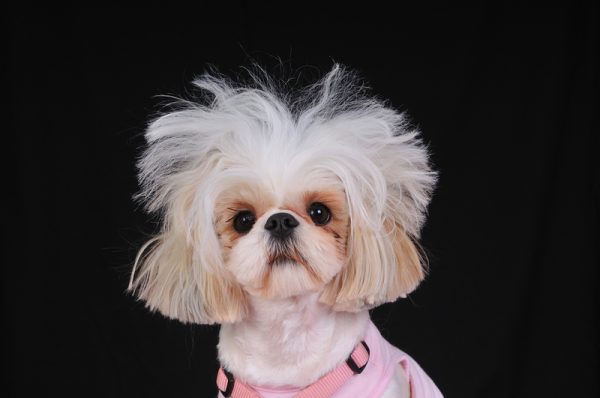
You won’t find the term, “shock headed” in the Shih Tzu breed standards of the AKC, Canadian Kennel Club, or the United Kennel Club, but it is a wonderfully descriptive phrase used to describe the robust outward-standing hair on a Shih Tzu’s head, particularly the way it rises and radiates from the skull and muzzle. The “shock” of hair creates a rounded, plush silhouette reminiscent of a chrysanthemum, and chrysanthemum is a word found in the breed standards with the UKC, as well as the FCI, and the UK’s Kennel Club.
From the FCI Shih Tzu standard: HEAD Head broad, round, wide between the eyes. Shock-headed with good beard and whiskers, hair growing upwards on the muzzle giving a distinctly ‘chrysanthemum-like’ effect. Not affecting the dog’s ability to see.
Though the term has limited usage in breed standards, more’s the pity as it is a distinctive hallmark of the Shih Tzu. The AKC standard calls for a head that is round, broad, and wide between eyes. Indeed, a narrow head is a fault: Needless to say, a rounded head with a plush silhouette is reminiscent of a chrysanthemum flower.
The reason the breed is “shock headed” is both genetic and historical. The Shih Tzu was developed as a companion breed very much favored in the imperial courts of China; an impressive, luxurious appearance was highly valued, and to that end, breeders selected for a broad head, short muzzle, and that abundant coat that served to accentuate the breed’s regal look. Over generations, this resulted in dogs with dense facial hair that naturally stands out and upward, creating the “shocked” appearance.
Coat texture plays a crucial role in achieving the breed’s shock-headed look. A healthy, long, dense double coat – not curly but sometimes with a slight wave – allows head coat to be easily directed or fall naturally. The unique structure and planting of the hairs on the Shih Tzu’s skull and face, in conjunction with the straight, somewhat plush texture of the double coat, are what allow for the desired “shock headed” silhouette rather than a simple length or heaviness of hair.
Here lies a seeming contradiction. The UKC, for example, calls for the chrysanthemum look, but it also states that “the hair on the top of the head is customarily tied up.” In fact, the AKC standard explicitly states that the hair on top of the head is tied up.
So, what is the point of tying up a coat that judges want to see “shock headed?”
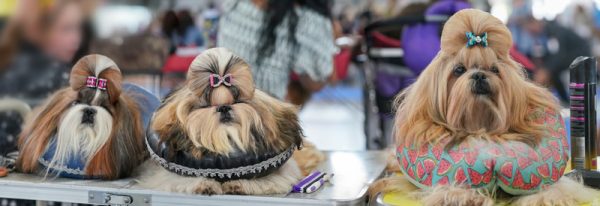
Photo by Luboslav Ivanko | Dreamstime.com
A topknot is not meant to undo or hide the shock-headed effect, but rather to preserve and showcase it in a structured, practical way. A topknot doesn’t diminish the chrysanthemum characteristic when it is done correctly. The topknot prevents eye irritation while maintaining the breed’s elegant silhouette, and in a show ring, judges still expect to be able to assess the quality and density of the head coat even when it is tied up, as it reflects the dog’s overall coat condition and adherence to the standard’s call for a “luxurious double coat.
From the handler’s perspective, a correct topknot (nicknamed the “bubble”) reveals important breed traits: a broad, domed skull, wide-set eyes, and a short, square muzzle. Without it, the natural abundance of facial coat can obscure these critical elements and even irritate the dog’s eyes. A “bloused” topknot” is a grooming technique used to create a looser, fuller topknot. An elastic band is placed securely (but not too tight) and the coat above the tie is gently teased or fluffed to give the illusion of volume and softness. Overblousing or exaggerating the topknot, can raise suspicion that it is camouflage to hide a structural weakness, such as a lack of fore skull depth or head width. A savvy judge may gently slip an index finger under the topknot to determine the dog’s actual head shape, width and depth.

Photo of Shih Tzu by © Anne Kitzman | Dreamstime