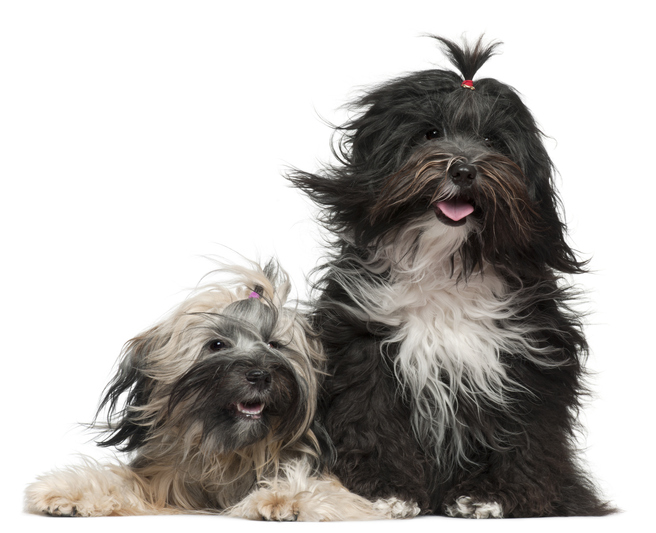
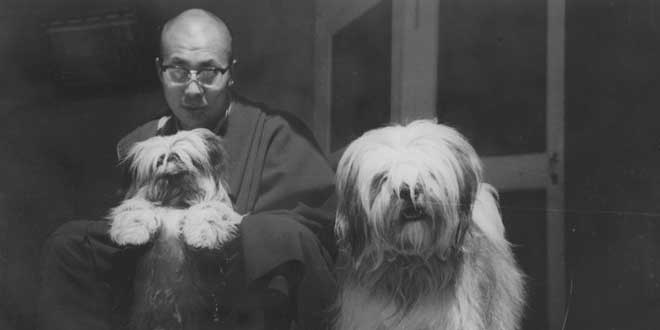
Early historians of Tibetan dog breeds can be forgiven for their confusion. Before the 1930s, the term “Tibetan Terrier” appeared in various writings, referring to two distinct breeds that differed in size and working roles but shared a historical presence in Tibetan monasteries and physical traits like shaggy coats and curled tails.
Even more confusion was caused by the fact that the breeds we know today as the Lhasa Apso and the Tibetan Terrier were also known as “Lhasa Terriers,” “Bhutan Terriers,” or “Thibetan Terriers,” without clear distinction. Limited Western exposure by visitors simply reduced the two breeds down to shaggy coats, curled tails, and an association with Tibetan monasteries. For a time, “Tibetan Terrier” seemed to be a catch-all term for medium to small shaggy Tibetan dogs.
Clarity came in 1930 when the Kennel Club of India officially changed the breed name from “Lhasa Terrier” to “Tibetan Terrier” to better reflect the breed’s distinct identity, and we have
Dr. Agnes Greig to thank for ending the inconsistency.
In 1922, Dr. Greig, a British surgeon working in India, had been given a female Tibetan Terrier named “Bunti” by a Tibetan grateful for a successful surgery.
Dr. Greig was so enchanted with Bunti that she exhibited her at the Delhi Dog Show in India, and judges unfamiliar with the breed were equally intrigued. They suggested that she acquire a mate and breed three generations in order to confirm the breed’s consistency.
Dr. Greig’s acquisition of a male Tibetan Terrier named “Rajah” and resulting litters are a topic for another day. This post focuses on how the standardization that distinguished the Tibetan Terrier from the Lhasa Apso also benefitted the latter as it was also recognized as a separate breed around the same time.
In 1904, Lieutenant-Colonel C.H.E. Adamson brought to England an unspecified number of Lhasa Apsos he had received as gifts from Tibetan officials. Nearly two decades later, American diplomats Charles and Marguerite Suydam received Lhasa Apsos as gifts from the
13th Dalai Lama’s kennels in Lhasa, and established their Hamilton Farm kennel in New Jersey. Their dogs, “Hamilton Buddha” and “Hamilton Seng Kye,” were key in defining the breed’s standard, and by 1930, the term “Lhasa Apso” was adopted to differentiate it from the Tibetan Terrier. The breed by that name was formally recognized by the Kennel Club of India in 1930, with the American Kennel Club following suit in 1935.
Photo of Tibetan Terriers by GlobalP iStock