
Are you familiar with the “Nine Dot” problem? This brain teaser presents nine dots arranged in three rows of three, and challenges the player to connect the dots using four continuous lines without lifting the pen. The solution hinges on connectivity, requiring lines that extend beyond the grid’s boundaries to unite all the dots. Many people erroneously believe that the phrase “thinking outside the box” comes directly from the solution to the puzzle (it didn’t. To our knowledge, the phrase was popularized in John Adair’s 1971 book, Decision Making and Problem Solving).On these pages, we look at most things through the lens of purebred dog advocacy. Connectivity, so crucial to solving the puzzle, reminds us of how very much like the Nine Dot Problem our dog breeds are.We use the Siberian Husky to illustrate.Owners can easily come up with more, but we see nine key traits that help make the breed what it is—a connection between the dots, if you will, that enable a Sibe to do its work. These traits don’t function in isolation; like the puzzle’s lines, they connect seamlessly. Reduced to their core, the traits are physical, behavioral, and physiological.

We start with what connects the Siberian Husky to its world: its feet.
- A Husky’s feet are compact, well-padded with thick, tough pads, and have tightly clustered toes. This design minimizes surface contact with snow and reduces sinking in loose, deep snow—think of it as a natural snowshoe. The foot pads contain a high density of mechanoreceptors that enhance proprioception, helping the dog sense where its feet are for better balance on uneven or icy terrain. Interdigital webbing—the skin and connective tissue between the toes—is a vestigial trait that helps the dog grip snow and prevents ice from building up. This is important for a sled-pulling dog as the feet provide traction and shock absorption and allow the dog to maintain stability and avoid injury during high-speed runs over snow or ice.
- Attached to those feet are legs, of course, and the Siberian Husky’s are powerful. Well-developed quadriceps, hamstrings, and shoulder muscles generate high contractile force, supported by a skeletal structure with strong, lightweight bones optimized for leverage. The breed’s angulation (moderate hip and shoulder angles, around 110–130°) balances power and stride length, reducing energy expenditure per step. It is these legs that provide propulsive force needed to pull sleds that can weigh over 100 pounds, legs with muscle fibers (predominantly type I slow-twitch) that are adapted for endurance over speed.
- Covering the legs and feet (and the rest of the dog) is a thick double coat consisting of a dense undercoat of short, fine hairs and longer guard hairs. The undercoat traps air warmed by the dog’s body heat to create an insulating layer that reduces heat loss even in temperatures as low as -50°C. Natural oils make guard hairs water-repellent, and this prevents moisture from penetrating and freezing. It’s believed that this thermoregulatory adaptation is rooted in the breed’s evolutionary history in Siberia’s Chukotka region, a critically important trait during prolonged exposure to extreme cold found in Arctic conditions.
- The Husky’s deep, broad chest houses a large thoracic cavity needed to accommodate oversized (also known as hypertrophied) lungs and a robust heart essential for endurance. Lung capacity (reflected in an estimated blood volume of 1.5 to 2 liters for individuals weighing 44 to 60 pounds) supports maximal oxygen uptake. A Sibe’s cardiac output during intense activity (like pulling a sled) can reach up to 300 mL/kg/min, efficiently delivering oxygenated blood to active musculature. This cardiovascular performance is further helped by an elevated erythrocyte count that increases the blood’s oxygen-carrying capacity. In short, this enables sustained aerobic metabolism under extreme physical demands. If you doubt this, challenge yourself to run like mad with 100 pounds of rocks in a backpack for even a mile on a frigid day.
- When we reach the dog’s back, we’ll find a highly flexible spine with loose intervertebral ligaments and a balanced musculature. This allows a wide range of motion, enabling the dog to have a loping gait with a stride length of nearly five feet. This gait reduces up-and-down movement, which in turn lowers energy loss, resulting in about 70% efficiency in kinetic energy use as compared to breeds with less flexible movement patterns. This energy-efficient stride allows a Husky to cover vast distances without excessive fatigue.
- A keen navigation instinct! Huskies have strong spatial cognition, and researchers think this is likely tied to increased activity in the hippocampus, along with greater use of smell and sight cues for navigation and memory. A Siberian’s ability to memorize trails and detect environmental markers (e.g., snow patterns, wind direction) is likely a behavioral adaptation from their origins where survival depended on navigating vast, featureless tundras. Again, scientists think this instinct is supported by a well-developed prefrontal cortex, aiding decision-making under stress. Anyone who has ever gotten turned around in a blizzard can appreciate how important this is. Navigation is what allows the lead Huskies to guide teams through snow storms or unfamiliar terrain and maintain direction and pace over long distances. It’s really incredible.
- High Energy! Huskies have a high proportion of type I muscle fibers (slow-twitch, for you athletes) that rely on aerobic metabolism for sustained energy output. In science-speak, their mitochondrial density is elevated, enhancing ATP production from fat stores (lipolysis), which is more energy-dense than glycogen. In plain English, this means that because the number of mitochondria is increased, the dog can produce more energy by breaking down fat. And because fat stores more energy than glycogen, this improves the dog’s ability to generate long-lasting energy. We know from races like the Iditarod that Huskies can maintain activity for 8–12 hours daily and burn up to 10,000 kcal in extreme conditions.
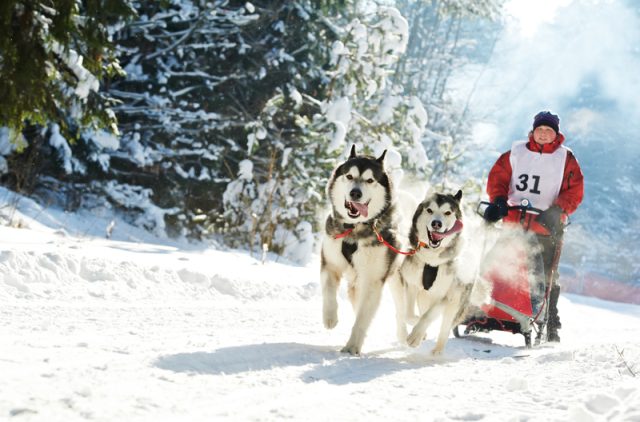
- Siberians are team players. They have a pack-oriented social structure, and while some of this is rooted in their evolutionary history, it is also mediated by oxytocin release during social bonding. Low aggression fosters trust and coordination within their team allowing Huskies to work cohesively in a sled team. Responsiveness to human cues make them good at following a musher’s commands, all while maintaining harmony under the stress of synchronized pulling.
And finally, we reach our 9th key point: An adaptation to cold. A Husky’s metabolism is tailored for cold environments, boasting a basal metabolic rate 1.5–2 times higher than non-Arctic breeds and effective heat production. Brown fat tissue generates warmth through non-shivering thermogenesis, and a reliance on fat metabolism over carbohydrates preserves glycogen reserves. This ensures stable body temperature and energy in freezing conditions. It ensures that the dog’s systems remain functional in harsh climates.