Say “Bert” and ________ to most anyone, and they will fill in the blank with “Ernie.”
Sesame Street’s most famous couple, Bert and Ernie, are two beloved Muppet characters who have appeared together in countless skits since the show’s earliest days. Few of us don’t know of them.
Say “Burt” and ____ to a Weimaraner fancier, and you’re apt to get a very different answer. The Weim owner who knows their breed history will fill in the blank with “Bert” (same pronunciation, different spelling). Burt and Bert were the famous “B” brothers, and the history of the Weimaraner in America cannot be told without them. The brothers, Bert v.d. Harrasburg and Burt v.d. Harrasburg, were whelped in Germany in 1948 by Max Baumier. Their parents were Sieger Arco v.d. Filzen (sire) and Siegerin Asta v. Bruckberg (dam), a pairing that produced dogs who would anchor the breed in America.
Bert went to Mr. and Mrs. Elvin Deal. Handled by Elvin Deal, the dog earned his championship in just seven shows, and then astonished the American fancy by taking Winners Dog at Westminster when he was less than a year old. Proving that he wasn’t just another pretty face, Bert was equally remarkable in the field. He became the first Weimaraner to win an Open All-Age stake against Pointers and Setters, a high-watermark achievement that showed the Weimaraner’s ability to compete on equal footing with established pointing dogs. Bert went on to tally 17 field trial victories, and when he was at the grand age of eleven years old, he was still running—and placing—in trials. His influence as a sire was equally noteworthy. He produced 21 champions, among them the sire of the first Weimaraner ever to win Best in Show in the United States, as well as winners of the 1953 National Open and National Amateur All-Age Championships. Bert’s accomplishments earned him a place on the 1955 Sports Afield All-American Team and eventual induction into the Weimaraner Club of America Hall of Fame in 1989. We should note how truly special Bert’s induction into the 1955 Sports Afield All-American Team was. It represented recognition outside the typical breed-focused circles at a time when most accolades for Weimaraners came from breed clubs, conformation shows, and field trials. This honor demonstrated that Bert’s abilities were acknowledged by a broader hunting and sporting community.
Bert’s brother, Burt, went to Franz Sachse. Like his brother, he earned his AKC championship and went on to influence the breed as a sire by producing 19 champions, his genetic influence carried forward to dogs such as Ch. Graves’ Rogue, a Best-in-Show winner. Burt’s Hall of Fame biography recalls him as a “birdy” and intense dog, known for retrieving birds from icy Alaskan waters while hunting with his owner. At home he was gentle, obedient, and protective. Burt died in 1959, but his legacy was also cemented when he, too, was inducted into the WCA Hall of Fame in 1990.
In the 1950s and 1960s, the names of both dogs appeared repeatedly in American pedigrees.
We have to remember that the Weimaraner was decimated in Germany following WWII. Burt and Bert’s puppies anchored critical kennel programs and helped re-populate the breed following the war. As both brothers were the classic silver-gray coat, their bloodlines reinforced the preferred coloration standard in the United States, and produced puppies known for stamina, keen scenting ability, and robust hunting drive. In short, the B Brothers embodied the dual promise of the Weimaraner breed as both beautiful show dog and a serious gundog.
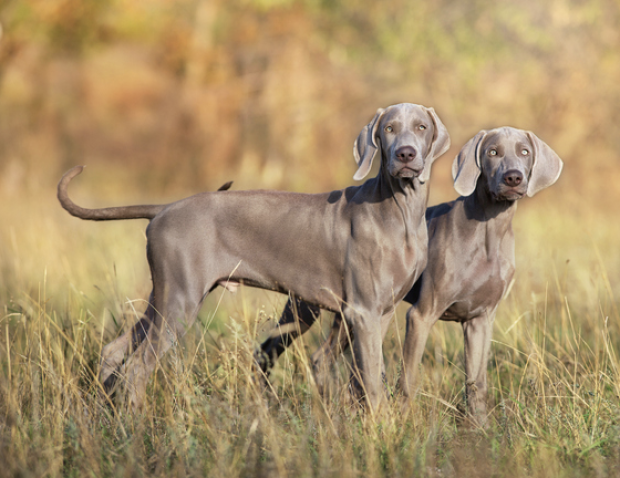
Image (not Burt and Bert) is by Callipso/iStock