
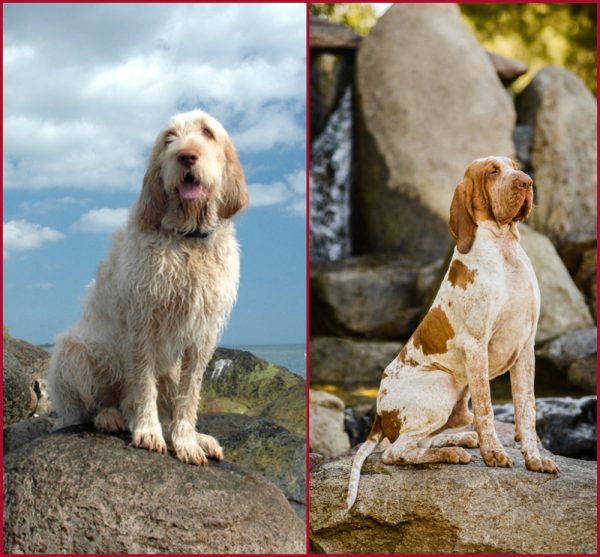
Italian dog experts (or cynologists) of the 19th and early 20th centuries often described their native breeds in poetic or romanticized terms, but it was Italian hunters who praised their ideal gundog as bello e bravo, or “beautiful and brave.” Far from being abstract or idealized virtues, bello e bravo described two living breeds we know today as the Spinone Italiano and the Bracco Italiano. The expression became closely tied to the cultural identity of the Spinone because of its dignified, rustic beauty and steadfast bravery in the field. The dogs worked tirelessly in thorny cover and cold water, showing what Italian breed fanciers often called both bellezza (beauty) and bravura (bravery).
With regard to the Spinone, the expression likely took root in the Piedmont region of northern Italy, where the breed originated. Some Italian sources and breed histories suggest that the sentiment predates formal written documentation, in which case it may have persisted as an oral tradition among Piedmontese hunters.
As to the earliest appearance of bello e bravo in print to describe a hunting dog, evidence points to a field trial report from Busto Arsizio, a large city near Milan, in 1895. The trial, organized by the Società Field-Trials Italiani, generated numerous eyewitness accounts, including that of judge and trainer Ferdinando Trebbi, who used the phrase bello e bravo in his follow-up notes to describe exceptional dogs—among them a Bracco Italiano named “Blitz,” owned by R. Osculati. The earliest printed record of the phrase appeared that same year in the Milanese hunting magazine Caccia e Tiri, which included Trebbi’s full report: “Blitz, del sig. avv. R. Osculati bello e bravo bracco di molti mezzi è capitato anch’esso in un momento disgraziato…” — describing Blitz as a “beautiful and brave bracco of great potential.” Because such magazines were the primary vehicle for circulating field-trial results among Italian hunters and breeders, the phrase quickly caught on.
A few years later, Arturo Vecchioni preserved and expanded these records in his 1899 volume, Il Cane in Azione o le Prove sul Terreno, which compiled Caccia e Tiri reports from 1892 to 1898, including the 1895 text verbatim. This virtually ensured that the phrase bello e bravo became part of Italian dog literature—and, in our view, it was all the more authentic because it originated with hunters and trainers, themselves.
We should also note a later milestone in the phrase’s connection to the Spinone: Carlo Cardini’s 1948 book Lo Spinone Italiano (Olimpia Editore), an important study of the breed’s morphology and history. In it, he emphasized scultoreamente belli (“sculpturally beautiful”) dogs whose field performance matched their appearance—a phrasing distinctly reminiscent of bello e bravo.
This early appearance of bello e bravo reveals more than just a turn of phrase; it shows how Italian hunters and dog men fused aesthetic admiration with practical excellence. Long before breed standards or show rings formalized such ideals, their praise of a dog as “beautiful and brave” captured the enduring balance of form, function, and soul at the heart of Italy’s sporting breeds.
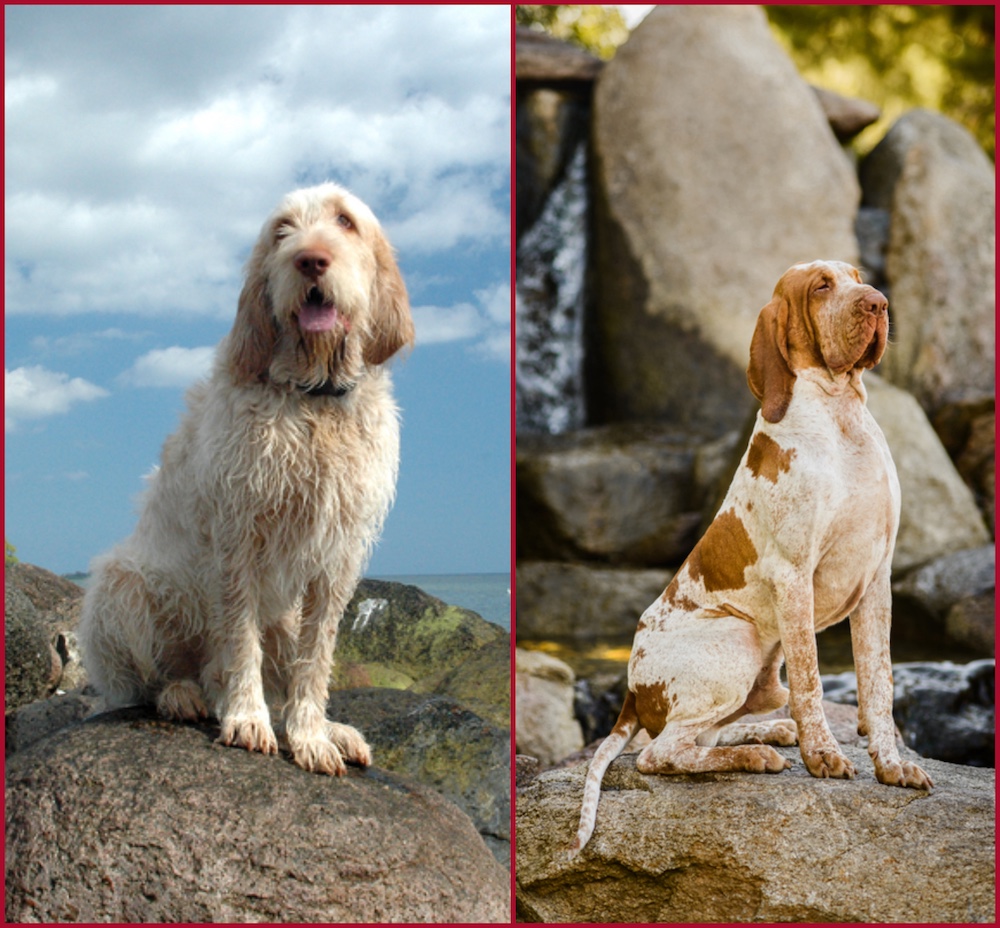
Image:At the left, a Spinoni Italiano by Kim Christensen; at the right, a Bracco Italiano by Olgagorovenko, both via Dreamstime