When we think about early canine media stars of yesteryear, the general public usually thinks of Rin Tin Tin, Pal (Lassie), and Strongheart. Total dog nerds will know of Luke, a dog whose breed would later be recognized as a Staffordshire Bull Terrier – he co-starred with silent comedians like “Fatty” Arbuckle and Buster Keaton. They might even know about Jean, the Collie known as the Vitagraph Dog. There is one more dog we don’t usually hear about.
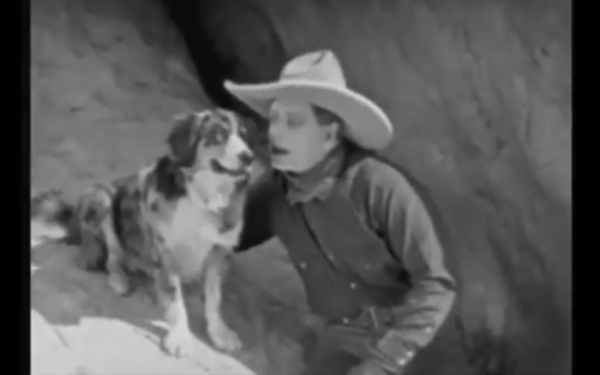
“Bunk” was a blue merle Australian Shepherd, one of early Hollywood’s most celebrated canine stars (and probably its first Aussie star) who made an indelible mark during the silent film era and into the age of “talkies.” He started his journey in Australia where a preeminent Western film actor of the 1920s, Jack Hoxie, arranged for a pregnant Australian Shepherd female to be shipped to the United States. During the ocean voyage, this female (whose name was never recorded) whelped a single surviving male pup—Bunk—who was partly raised by sailors until their arrival at Universal Studios in San Diego, where Hoxie personally took the pup into his care. While some accounts connect Bunk’s Australian heritage to the legendary Olympian and horseman Snowy Baker, most accounts trace Bunk to authentic Australian working stock.
From his earliest years, Bunk, extraordinarily smart, proved to be quite adaptable. His talents were fortified under Bert DeMarc, a respected animal trainer and occasional bit-part actor. The pair had training sessions on Western sets as well as at Hoxie’s Broken Arrow ranch in Hereford, Arizona. There, routines included not just obedience and tricks but complex action stunts that were not only vital for Bunk’s film career, but kept the intelligent dog from becoming bored.
Bunk lived with Hoxie, accompanying him both on set and off, and traveled with him into Canada, Mexico, and across the Western United States. Hoxie spoke often of his loyal companion, claiming Bunk would ride horseback and, when called for, even advance the movie’s plot by outsmarting villains or executing precise rescue scenes. The partnership between the pair was strong.
Bunk’s screen debut was as a pup in Ridgeway of Montana (1924), and he instantly captured the hearts of Western film audiences. His fame grew rapidly, with central appearances in The White Outlaw (1925), a film notable for still having surviving reels in archives. You first spot Bunk at the 3:31 mark at this video clip.
Bunk’s cleverness was showcased in Hidden Loot (1925), where his actions helped save Hoxie’s character from great danger. Other films in Bunk’s busy career included Fighting Fury (1924), Red Hot Leather (1926), The Demon (1926), The Fighting Peacemaker (1926), Rough and Ready (1927), The Western Whirlwind (1927), The Rambling Ranger (1927), and Little Shepherd of Kingdom Come (1928), the last movie marking a rare appearance without Hoxie. Occasionally, a lookalike son or relative may have filled in for Bunk in later productions, but frustratingly, records are fuzzy because of the era’s documentation limitations.
After years as Hollywood’s “smartest dog,” Bunk’s legacy was firmly cemented by both his on-screen accomplishments and his close-knit life with Hoxie. Bunk reportedly died on a show tour, and according to Hoxie’s own accounts, he was buried by cowboy friends on Beaver Creek in Texas, having lived to the remarkable age of 18. Today, Bunk is remembered not only for his pioneering role as a canine actor but also as a beloved companion whose story illustrates the deep connections forged between dogs and their people during the formative years of American filmmaking.
Image of Bunk believed to be in the public domain