Call us crazy, but when a breed standard devotes a fair amount of ink to a particular aspect of the dog, we interpret that to mean that the described attribute must be important.
But a tail?
A full 87 words are devoted to describing the Scottish Deerhound’s tail in its AKC standard.** By comparison, the Puli’s standard uses ten words to describe the same appendage. And we hope that just now, you thought to yourself, “Apples and Oranges, NPDD!” or something like that. Because if you are a regular reader of these pages, you know to ask yourself why a breed standard – or any part of it – is written the way it is – and it typically comes down to the breed’s original function.
Answering why a Scottish Deerhound’s tail matters enough to take up valuable “ink real estate” in a standard has everything to do with its role in running down and bringing to bay wild red deer in the Scottish Highlands. Historically speaking, it lived to stag-hunt for Highland nobility and clan leaders, To that end, the breed had to course over rough, mountainous Highland terrain, and that called for speed, stamina, and the strength to pull down large stag that could weigh several hundred pounds.
So about that tail…..
Let’s start with what the standard says: “Tail: Should be tolerably long, tapering and reaching to within 1½ inches of the ground and about 1½ inches below the hocks. Dropped perfectly down or curved when the Deerhound is still, when in motion or excited, curved, but in no instance lifted out of line of the back. It should be well covered with hair, on the inside, thick and wiry, underside longer and towards the end a slight fringe is not objectionable. A curl or ring tail is undesirable.”
If you truly want to understand how a tail helps the Deerhound, we want you to do a quick and simple test at home:
-
Stand in the middle of a room, your feet shoulder-width apart;
-
Cross your arms tightly over your chest and slowly turn your whole body 180° left, then 180° right several times, trying to stop crisply each time;
-
You’ll notice that it’s a little hard to stop exactly where you intend to stop without wobbling or over-rotating;.
-
Now do the same thing over again, but this time, let your arms swing freely and deliberately swing them in the direction you’re turning (your arms and body turn together);
Most people feel that turning and stopping is smoother and more controlled when their arms are free. This is because swinging your arms act as movable mass that helps manage rotation and balance, the way a dog’s tail shifts to counterbalance the body in a turn.
The Scottish Deerhound standard’s tail description makes clear: the tail isn’t cosmetic. It is a functional part of the dog’s ability to run, balance, and turn at speed. The wording “tolerably long, tapering and reaching to within 1½ inches of the ground” describes a tail long enough to act as a counterbalance, much like a rudder, helping the dog control its body during rapid acceleration, deceleration, and sharp turns on rough terrain.
The requirement that the tail be carried “dropped perfectly down or curved when still” and, when moving, “curved, but in no instance lifted out of line of the back” shows the importance of correct tail carriage: if the tail is lifted high, it no longer helps the dog manage balance and torque; instead, it disrupts the smooth topline and shifts the dog’s center of gravity upward, reducing agility. By insisting the tail stay in line with the back, the standard preserves the natural, functional position that lets the Deerhound use its tail as a stabilizing lever while running over uneven ground or executing swift lateral turns when pursuing deer.
And although the standard doesn’t explicitly state that the tail is “used as a rudder,” its required length, low carriage, and flexibility imply that this long, low tail serves as part of the dog’s steering and braking system rather than being a ‘rear-end hood ornament.’ A curl or ring tail would shorten the effective length and pull the mass up and in, so disqualifying that shape reinforces the same point: such a tail cannot swing freely as a counterweight, and is therefore less useful for maneuvering.
And what about the “well covered with hair… thick and wiry” bit? They, too, reflect function. A properly coated tail resists injury from brush and heather without adding heavy feathering that could snag or drag.
Altogether, this standard’s wording preserves a tail that is long, low, flexible, and working in harmony with the Deerhound’s spine—exactly the design a Deerhound needs to run with stability, and to turn cleanly at speed. We weren’t too successful in finding a video to illustrate the aforementioned information, and the one we did find shows the Deerhounds being a little silly, but if you focus on their tails even as they are goofing around, you’ll see that the tails are never stationary, and that they shift during turns:
@dogtrainer_morgan Tally Ho! #scottishdeerhound #lurecoursing #dogsports ♬ Super Mario 64 Slider Racing Song – namasty.woman
**Many breeds, especially sighthounds, have robust descriptions of their tails.
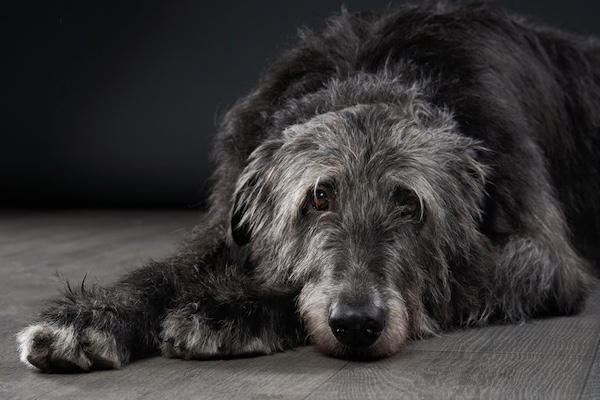
Image of Scottish Deerhound by averyanova/DepositPhoto