It all started with an article we read this morning, “10 Words You’ve Probably Been Mispronouncing for Years.” Among the words are Pho and Açai (and now we’re hungry), but another one is Boatswain which, as most Newfoundland owners know, was the name of Lord Byron’s Landseer. The word/name should be pronounced “BOW-sun” (and to that end, “coxswain,” the captain of a rowing team, is pronounced “COX-sun”).
If you own a purebred dog, chances are you’ve heard your breed’s name mispronounced at least once in your life. Some names are understandable, as in Xoloitzcuintli (“show-low-eats-QUEENT-lee”) and Coton de Tulear (co-TAHN de TOO-lay-are). But Dachshund?????
According to research from Mental Floss, Reddit, Unscramblerer.com, Bark magazine online, and WalesOnline, Dachshund was the most mispronounced breed name in 2025. Dachshund owners have likely heard it all:
-
“dash-hound”
-
“dashund”
-
“docks-hound”
-
“doxen” / “doxin”
-
“doxun”
And before we forget, a little public service announcement: Even though many owners and even breed sites use “Doxie” as a normal informal nickname for a Dachshund, historically speaking, “Doxie” has meant a mistress, prostitute, or (let’s be frank), sexually promiscuous woman. The word is still recorded in modern dictionaries as archaic, but derogatory. Some writers warn that spelling the nickname as “doxy/doxie” could have an unfortunate double meaning among purists or an older generation. Just saying.
No kennel club or registry database has systematically catalogued the most mispronounced breed names, but we all know there is no shortage of other names routinely butchered – and such lists do exist even though they are largely editorial or anecdotal. Still, we have to concur with them because we’ve heard the mispronunciations for ourselves. We decided to look for consensus, and based on the overlap across many dog‑site/fan‑site articles and pronunciation guides, we found that the top 10 most frequently listed mispronounced dog breeds are, in no particular order after Dachshund: Shih Tzu, Rottweiler, Papillon, Weimaraner, Bichon Frise, Keeshond, Lhasa Apso, Vizsla, Newfoundland.
It is honestly baffling to us that many of these breeds have been around for ages, others have frequently appear in movies or on television. One would think that breeds familiar to the public wouldn’t still be so often mispronounced.
What the heck?
When we did a little digging as to why people mispronounce names we think they should know, we came up with a list of our own:
- The first time that a lot of people “meet” a breed is through print. It might be a meme, an article, or the caption under a photo of a dog they find appealing. It is human nature to “sound” out a word in your native language, and in this country, that language is English, so even when a breed’s name is originally German, French, Chinese, Japanese, etc., we use English rules when sounding a word out. Because the brain links spelling, sound, habit, and social cues, an early “guess” at a name tends to stick, and “unlearning” it is like trying to break a bad habit. Once a mental version like “dash-hound” (Dachshund) or “rock-wy-ler” (Rottweiler) forms in our head, hearing the correct pronunciation on TV or a movie is often too brief to overwrite our learned version. Our guessed pronunciation becomes the default;
-
We read that because the human brain uses its existing sound system to interpret unfamiliar words, we tend to treat foreign spellings as hints rather than precise instructions, so it’s almost predictable that mispronunciations occur;
-
And because English spelling is already somewhat irregular, and many breed names add silent letters, missing accents, and regional variants, people who have never heard a native speaker or breeder say the name feel forced to guess at it. Circling back to #1, we arrive at the person who repeats their guess time and time again even though it’s wrong; Outside of a dog show, or hanging out with breeders or groomers), mispronunciations are rarely corrected, so the errors pass from one generation to the next.
-
And honestly, are those of us who are fanciers a teensy bit to blame when we, for example, affectionately call a Bichon Frise a “bitch’n frisbee?”
-
We’ve read that humorous mispronunciations tend to entrench substitutions, and that long or complex names like Weimaraner, Lhasa Apso, and Keeshond tend to encourage shortening. Simplified versions tend to stick over time. We’re not so sure it takes a long or complex name to be dismantled. Our own breed’s name is only four letters long and two short syllables, but we’ve heard ‘Puli’ pronounced “Pyu’lee,” and to our ear, it’s like fingernails-down-a-chalkboard. We bet some of you reading this have your own version.
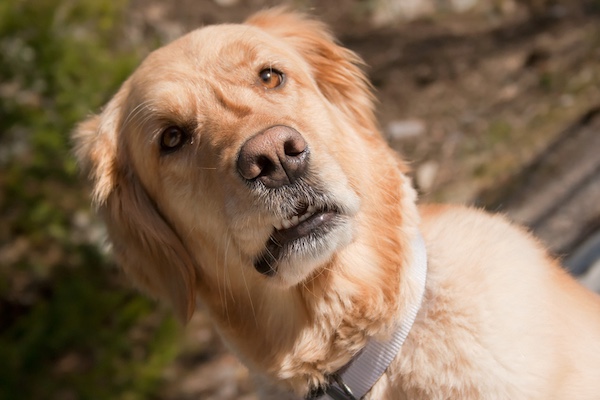
Image of a puzzled Golden Retriever by Emily Skeels