
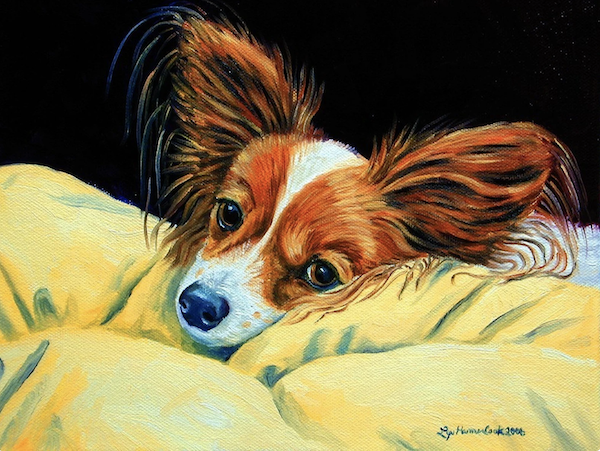
The history of purebred dogs is dotted with examples of breeds that have “dual citizenship”—that is, breeds for which two countries can legitimately claim influence on their development. The cleanest, least disputable example of a true dual-country breed is one whose very name reflects this: the Danish–Swedish Farmdog. Other breeds are less precise in their monikers, but no less genuine in their shared national heritage; in this post, we turn to the Papillon.
In a review of breed history, the Papillon Club of America admirably explains the origin of what was once called the Continental Toy Spaniel (Papillon being the modern representative).
Its origins can be traced to Western Europe as early as the beginning of the 16th century, most famously through the small spaniels depicted by Titian and other Renaissance painters. These dogs appeared consistently in France and the Low Countries, where their popularity in royal and aristocratic courts encouraged deliberate and intensive refinement. Over time, breeders—particularly in France and Belgium – exerted the most influence.
France can be credited with the early development of the Continental Toy Spaniel, particularly the long-established drop-eared type, the Phalène. Small spaniels of this type appear consistently in French court life and artwork from the Renaissance through the 18th century, establishing France as the breed’s historical foundation.
Belgium, however, played a decisive role in the perfection of the erect-eared form, which later became known as the Papillon. Belgian breeders refined, stabilized, and popularized the upright ear carriage that gives the breed its butterfly-like appearance.
How do we know any of this?
Enter Baron Houtart.
Albert Léon Marie Houtart (born in 1887 and died in 1951) was a Belgian baron, lawyer, magistrate, and provincial governor of Brabant.
We found nothing to explain why this man, not a historian or cynologist by training, wrote a focused historical and descriptive study of the Continental Toy Spaniel, but his Les Épagneuls nains continentaux published in 1925 has long been cited by kennel clubs and breed historians, as an authoritative chronicle of the breed’s early development. Houtart’s monograph-style work on breed history was influential because it provided a systematic historical narrative that earlier sources lacked. Both the Papillon Club of America and the AKC Study Guide refer to Houtart’s work when discussing how the breed’s development occurred across Western Europe, rather than in one nation — and they credit Les Épagneuls Nains Continentaux as “the most authoritative work on this subject.”
Houtart demonstrated through citation that the Papillon didn’t emerge as a finished breed in a single country, but through continuous breeding, refinement, and selection on both sides of the Franco-Belgian border. Because the breed’s origin, development, and final type are inseparably linked to the work of breeders in both nations, neither can claim exclusive authorship, though the casual dog owner may erroneously point to the breed as being French.
Image: Papillon by Lyn Hamer Cook/DogArtByLyn
www.facebook.com/PetArtbyLyn
www.petart.net
www.corgiart.net