If you’ve ever tried to record a grandparent’s recipe as they cooked, you’ll have discovered their measurements were just a ‘pinch of this’ and a ‘smattering of that.’ They cared more about making the dish delicious than recording how they did it.
Tracing the origins of the Yorkshire Terrier is a little like getting a recipe from a grandparent whose measuring spoons were fingertips, fists, and instinct while you long for the precision of tablespoons, ounces and cups. To continue the metaphor, early Yorkie breeders tossed in a “handful” of Waterside Terrier and a “dash” of Paisley with the confidence of someone who knows exactly what the end result needed to be. Alas, by the time miners and mill workers of 19th-century England arrived at the final product, the three primary ingredients of the “dish,” the Waterside, Paisley, and Clydesdale Terriers—had been wiped from the shelves of history entirely. Today, we are left a canine masterpiece, but the original recipe is inferred from period accounts, appearance and educated eyes.
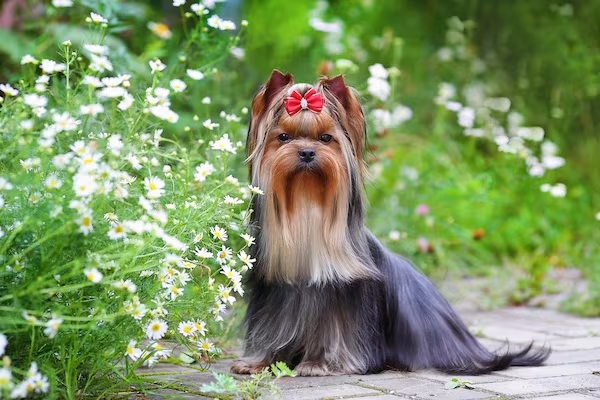
In this post, we focus on the Clydesdale Terrier, most likely the “mystery ingredient” of the Yorkshire’s recipe that explains why the breed looks like a supermodel but is capable of acting like a street fighter. Long vanished but once fiercely debated, the Clydesdale Terrier emerged in 19th-century Scotland as a deliberate departure from the rough, purely functional terriers of the farmyard. Closely related to the Skye Terrier, it represented an early experiment in breeding for elegance rather than endurance, retaining terrier structure while transforming the coat into something altogether different. Where working Skyes carried harsh, weatherproof hair, the Clydesdale was prized for a flowing, silken mantle in pale silver-blue tones that caught the light and announced refinement at a distance. This emphasis on appearance placed the breed at the forefront of the growing Victorian dog-show culture, making it one of the earliest terriers shaped primarily by aesthetic ideals rather than utility.
The Clydesdale Terrier is frequently entangled in historical debate with the Paisley Terrier, a confusion that speaks more to geography and custom than to meaningful difference. Dogs of the same silky, drop-coated type were known by different names depending on whether they were discussed locally or exhibited in the ring, with “Clydesdale” favored in formal show contexts and “Paisley” commonly used in everyday speech. Both names described a terrier of moderate size—larger and heavier than the modern Yorkshire Terrier—with profuse furnishings on the ears and a coat texture so soft that it was admired and criticized in equal measure. To admirers, the Clydesdale represented the height of refinement; to traditionalists, it was a betrayal of the terrier’s working identity.
The very traits that made the Clydesdale visually appealing made it impractical for real labor. Its long, fine coat tangled easily, collected debris, and demanded constant care, making it unsuitable for the rough environments in which terriers traditionally proved their worth. As smaller, silk-coated terriers began to emerge in northern England through deliberate crossings with local ratting dogs, the Clydesdale’s influence was absorbed rather than preserved. Breeders favored a more compact, lower-maintenance version of the look, and within a few generations, the Yorkshire Terrier eclipsed its elegant predecessor. By the early 20th century, the Clydesdale Terrier had disappeared as a distinct breed, leaving behind no studbooks or surviving examples, only its unmistakable legacy in the glamour, carriage, and polished coat of the Yorkshire Terrier—a ghost breed whose beauty lives on in every Yorkie that struts as if it knows exactly how good it looks.