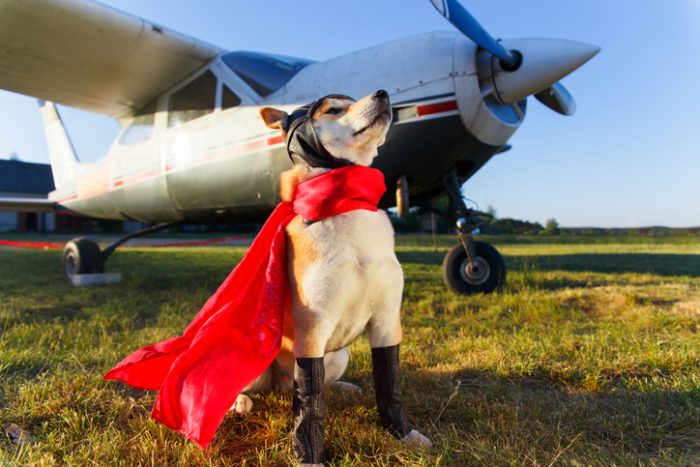
This image of a red-scarfed Shiba Inu taken by Aliaksei Smalenski went viral as soon as it was uploaded to Pexels (a free-to-use stock photo site) in 2018. The photograph shot at a small airfield in Grodno Region, Belarus showed up in thousands of blog posts, advertisements, and social media posts and came to be referred to as the, “Aviator Dog.” Unfortunately, the photo sites had the dog identified as an Akita Inu, including Pexels, but dog people knew better.
We share another photo taken of the same dog and theme, 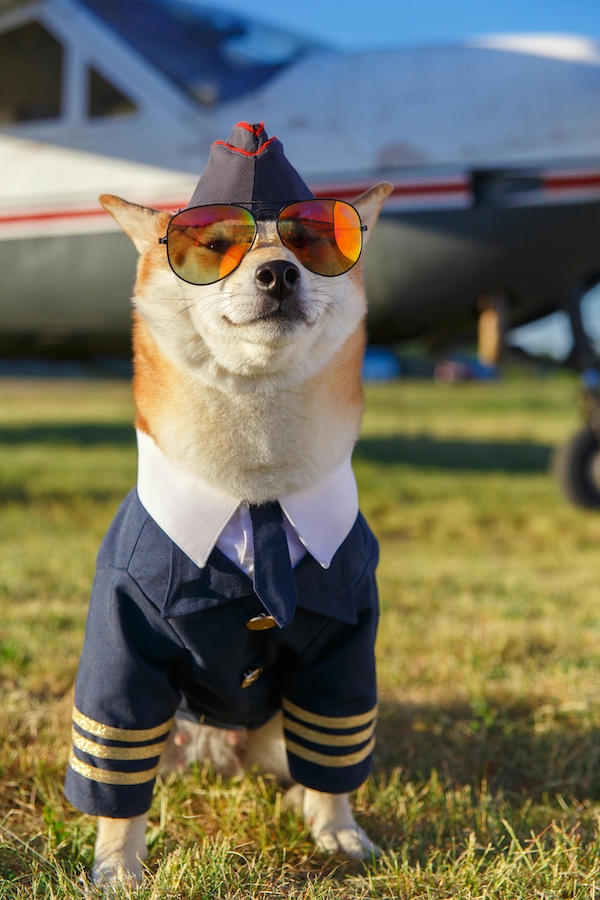 but the pictures aren’t the point of the post (we just liked them too much not to share). Our point is, if you’ll forgive us, a “dog nerdy” topic.
We came across a fascinating study that may be of interest to Shiba owners, “Differences in allele frequencies of personality-related genes in three varieties of Shiba Inu in Japan,” published in Animal Genetics in June 2025.
The paper ultimately validated what many Shiba Inu owners, breeders, and preservationists have argued for years: the so‑called regional Shibas of Mino and San’in are not merely cosmetic variations, but genetically distinct populations, clearly separable from the more common pet‑type Shiba Inu. Their work shows that the differences run across the genome, pointing to deep, long‑standing population structure shaped by geography and functional hunting selection, not just modern pedigree fashion or show‑ring trends in conformation.
What this really boils down to is that some Shiba populations are wired a bit differently from the inside out. Work on the oxytocin receptor gene, OXTR, shows that certain variants tweak how strongly a dog’s brain responds to oxytocin, the hormone that underpins social bonding and stress buffering. Dogs carrying one version tend, on average, to orient more toward people, seek proximity, and lean on their owners when stressed, while others are more reserved, slower to use human contact as their coping strategy, and more inclined to solve problems on their own. LRRTM4 sits in a different part of the story: it helps shape excitatory synapses in brain circuits involved in learning, motivation, and predatory or work‑related behaviors. Shifts in how often particular versions of these genes appear in a given Shiba population don’t give you a simple “OXTR = friendly, LRRTM4 = prey monster” equation, but they do nudge the baseline. In practical terms, regional hunting lines that are enriched for certain variants are more likely to produce dogs that are independent, environmentally focused, intensely committed to hunting tasks, and less automatically people‑centric than the average urban, pet‑bred Shiba—before training, lifestyle, or handler skill ever enter the picture.
Taken together, the genetics and behavior work support the notion that Shibas carrying older regional hunting ancestry can present as a very different dog from the average pet‑bred Shiba, even when they grow up in roughly the same kinds of homes. In real life that difference often looks like more independence, narrower and more selective social bonds, a harder, more persistent hunting motor, less tolerance for intrusive handling from strangers, and a tendency to go up—and stay up—under stress. These dogs—absolutely trainable—usually do best with steady, low‑conflict handling and thoughtful control of arousal, which fits with a nervous system and behavioral toolkit sculpted by generations of functional hunting work rather than by modern pet expectations alone.
All photos by Aliaksei Smalenski