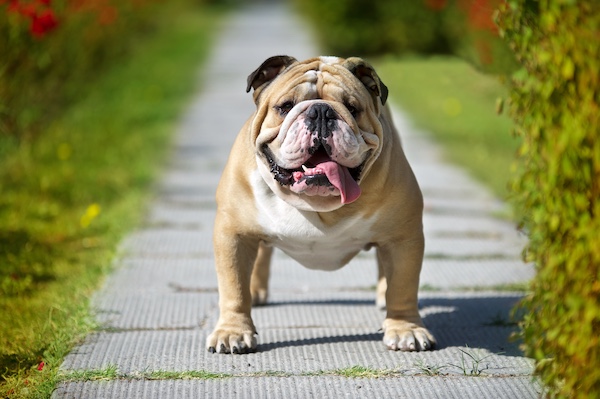
Quick, what color is this Bulldog?
Let the question percolate in the back of your mind for a few minutes because here we pivot to the 1865 “Philo-Kuon” Bulldog standard. The reason we pivot will become apparent later in the post, but for now, it’s helpful to know that the “Philo-Kuon” Bulldog standard written by Samuel Wickens in 1865 is generally regarded as the first true written standard for the Bulldog breed (some cynologists even believe it may have been the first formal written breed standard for any dog breed). Why? Because while earlier descriptions of Bulldogs did exist, they were narrative descriptions, not structured standards. Philo-Kuon was the first to set out specific, idealized points of type intended to guide breeding and judging.
Ready for another pivot? (of course you are): Today, the AKC accepts eleven different colors, and six different markings. The variety makes every individual Bulldog a unique character (which, truth be told, they are to begin with), but we mean in terms of their skin suit. Those colors are Brindle & White, Fawn, Fawn & White, Fawn Brindle & White, Red, Red & White, Red Brindle, Red Brindle & White, White, Fawn & Brindle, and Fallow.
Our opening question asked you to name the dog’s color, and we’re guessing many of you said ‘fawn.’ It’s an easy mistake to make, but the correct answer is fallow, and that color first appeared in the “Philo-Kuon” Bulldog standard all those years ago (see what we just did there?). The mistake is an easy one to make because genetically, a fallow Bulldog is best thought of as a fawn/red dog whose pheomelanin has been lightened by intensity and/or dilution modifiers, producing a pale cream‑tan or buff version of fawn rather than a separate color category with its own distinct locus.
To our 21st century mind, it’s an odd word to describe a color, and it can cause confusion because it is not a single, sharply defined color but a loose descriptor for pale, washed-out fawn shades—a bit of a “fudge” term by our modern standards. It was never meant to be precise, but to Victorian readers, fallow was immediately clear because it drew on familiar references: fallow deer and fallow land, all evoking a shared image of light, deer-hide tan rather than rich red. Hat tip to the Bulldog Club of America which still includes fallow and treats it as fully standard color even though the color (our impression, anyway) isn’t seen as often as the other colors. Fallow Bulldogs almost certainly existed before 1865 as unstandardized working dogs, but the first traceable, formal incidence in writing is that 1865 color clause.
A fallow Bulldog is best described as a pale variant of a fawn (pheomelanin‑based) coat, in which red or yellow pigment appears lighter while black or brown eumelanin remains fully expressed. It is not a discrete Mendelian color but rather a visual variation of an Ay/Ay (fawn/sable) background, with its appearance influenced by modifiers of pheomelanin intensity. Variants at the MFSD12‑based Intensity (I) locus can produce cream‑to‑white pheomelanin in several breeds, though this mechanism has not been specifically demonstrated in Bulldogs. In breed standards such as the BCA’s, “fallow” is a traditional descriptive term for a paler, less saturated tan within the accepted color range, rather than evidence of a unique genetic pathway. Accordingly, “fallow” is best treated as a legacy name for a diluted-looking fawn phenotype; there is no evidence for a dedicated “fallow gene,” and pheomelanin intensity is understood to be a quantitative, polygenic trait shaped by multiple loci.
If you are ever lucky enough to spot a Bulldog of this color, remember that you are gazing upon a living piece of Bulldog history that is carrying the legacy name, fallow. It’s a reminder that every Bulldog’s coat is more than just color (as is the breed itself). It is a story of breeding, genetics, and tradition all rolled into one unforgettable “skin suit.”
*The AKC was founded in 1884
Image of a fallow Bulldog by Tatiana Katsai/AdobeStock