Some people read breed standards the way other people read the back of a cereal box while chomping on their Cheerios.
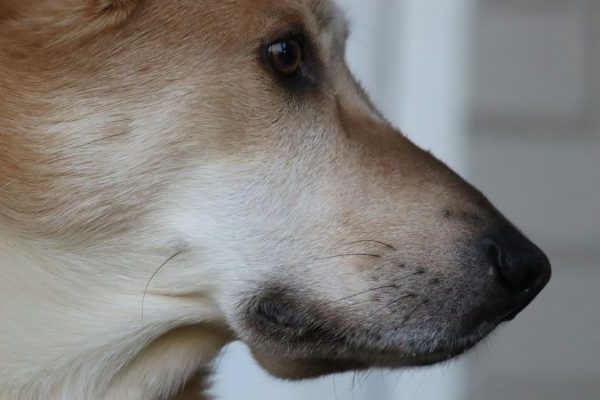
Sheepish grin. Okay, it’s us. We read breed standards the way other people read the back of the cereal box while munching on Cap’n Crunch. As we looked over the Chinook’s AKC standard, we were struck that this impressive, American-born sled dog is called to have an aquiline muzzle.
We tend to approach breed standards with two questions: “Why?” and “How?” Why is a standard written the way it is, and how does the feature described help the dog do the job for which it was intended? While an aquiline muzzle in the Chinook is a visual hallmark of the breed, we have to ask how it functions as part of a practical headpiece for a long-haul, cold-climate sled dog.
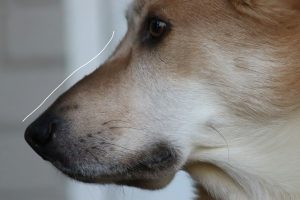
In ordinary usage, “aquiline” suggests a slightly convex or Roman‑nosed profile, the kind of nose often likened to an eagle’s beak. In the Chinook, however, the standard uses the term more specifically, defining the muzzle as aquiline “having a slight dip just before the nose leather,” with the muzzle shorter than the topskull (approximately a 2:3 ratio from nose to stop versus stop to occiput). From the front, it tapers to a blunt wedge; from the side, it runs nearly parallel to the skull’s topline, flowing into a broad head with a large, solid black nose and black lips. Breed-club and judging materials underscore that the muzzle should never be long, pointed, or Collie-like, but instead present as a strong, slightly shorter aquiline foreface that balances the broad topskull.
The breed developed in early‑20th‑century New Hampshire by Arthur Walden functioned as a sled dog that could both freight and race, a dog that could combine the power of heavier freighting dogs with the speed and endurance of lighter northern sled dogs. An aquiline muzzle contributes to the Chinook’s dignified, workmanlike head and helps distinguish it from other sled‑dog silhouettes, to be sure, but it is also a hallmark of breed type, tied to the look of the founding dogs. Breed standards don’t always spell out the “why,” and in this case they didn’t assign a specific working function to the slight dip itself.
From a functional standpoint, what we can say with confidence is that a substantial, normally proportioned muzzle gives the Chinook ample room for the nasal passages and the scrolls of vascular turbinates that line them. In extreme cold, those structures help warm and humidify frigid air before it reaches the lungs, reducing some of the respiratory irritation and stress associated with hard work in low temperatures. In that sense, the canine muzzle and nasal cavity act like a built‑in heat exchanger on the front of the dog. That is a general mammalian and canine adaptation, however, and belongs to the muzzle and nasal cavity as a whole, not specifically to the small aquiline dip described in the Chinook standard.
Similarly, the standard’s call for a blunt, substantial foreface and a large, solid black nose emphasizes durability and pigment at the “working end” of the dog. Like many working breeds with well‑pigmented noses and lips, Chinooks have melanin in exposed areas that can help protect tissues from environmental insults such as sun and glare, even though the standard does not state that black pigment was selected specifically as a snow‑glare shield. The judges’ and breed‑club materials focus on this head as a piece of correct type and balance; they do not claim that the aquiline contour itself sheds snow better or confers a unique respiratory edge.
A blunt, substantial muzzle—rather than a long, narrow, or extremely refined one—also aligns with the practical realities of a sled dog that must eat, breathe, and work hard in demanding conditions. It avoids the respiratory compromises associated with extremely shortened faces while steering clear of the snipey, Collie‑like profile the standard warns against. Again, that is about overall proportion and substance; a dog could theoretically have a blunt, functional muzzle with or without the slight dip.
All of this lives alongside the Chinook’s other working adaptations: a dense double coat for insulation, moderate but not clumsy bone, compact, well‑furred feet with thick pads, and a smooth, easy, efficient gait that lets the dog cover ground without wasting energy. Those features clearly belong to its heritage as a freighting and racing dog in challenging conditions.
Within that bigger picture, the aquiline muzzle is best understood as a defining mark of Chinook breed type—a nod to its foundation dogs and a visual signature that sets it apart—sitting on an otherwise thoroughly functional sled‑dog head. The nasal cavity still does its job as a heat‑and‑moisture exchanger, and the overall muzzle proportions support working endurance; the slight dip is a small contour that tells you you’re looking at a Chinook.
Image of a Chinook by Gabriela Natiello