A Chow Chow’s color may be the first thing you see—but it’s the last thing responsible breeders treat as “special.” Red and black are generally the most common Chow colors, while cinnamon and blue are less commonly seen but not truly “rare” in the sense of being more valuable. All five sit within the same tightly defined palette of colors recognized by the AKC breed standard: red, cinnamon, black, blue, and cream.
Within the framework used by the AKC and the parent club, none of the accepted Chow colors is officially ranked as rarer, more desirable, or more valuable than the others.
Our caveat?
Buyer beware of breeders who say otherwise.
Reds and blacks are described as the breed’s predominant colors, and they are the ones most of us encounter most frequently. Cinnamon/fawn and blue are traditionally described by the parent club as dilute forms of red and black. They are less commonly seen, but club materials also make the point that they are not actually rare and should not be marketed as special or premium colors.
Some people single out fawn—essentially a cinnamon or fawn shade—as relatively uncommon, but when we encounter such discussions on forums, they often appear in the context of marketing or warnings about labels such as “lilac” that exaggerate color rarity.
The five standard colors have remained consistent in AKC and parent-club materials, and responsible breed advocates discourage the invention of commercial “rare color” labels. Names such as champagne, silver, lilac, lavender, chocolate, or white do not create additional Chow colors beyond the five recognized by the standard.
Red has long been treated as the classic Chow color in general-audience descriptions, while black is also strongly represented and widely recognized as a predominant color. Blue and cinnamon have long-standing places within the breed’s accepted palette, even though they are encountered less often than red and black.
We aren’t geneticists, and coat-color genetics rarely behaves as neatly as a paint chip chart. A dog’s visible color reflects interactions among genes governing the kind of pigment produced, where it appears, and how intensely it is expressed. That’s why responsible discussions of Chow color should be cautious about assigning every shade one simple dominant-or-recessive formula.
Cinnamon is traditionally described as a diluted form of red, and blue as a diluted form of black. Some pigment-dilution variants are recessive and can therefore be carried unseen, but Chow color inheritance involves more than one gene and should not be reduced to a single formula that supposedly explains every cream, cinnamon, or blue Chow.
The parent club also observes that pigment in dilute Chows is seldom as intensely blue-black as it is in reds and blacks and may lighten with age. Because the standard requires a solid blue-black tongue and calls for dark brown eyes, preservation breeders pay close attention to pigment quality regardless of coat color.
Parents that appear red or black can sometimes produce cream, blue, or cinnamon puppies when both carry genetic variants not apparent from their own coats. Exactly which colors a mating can produce depends on the complete collection of color genes inherited from both parents, not merely on the colors visible in front of you.
That helps explain how a less commonly seen color can sometimes appear unexpectedly in an otherwise familiar-looking pedigree.
So the next time someone tells you a blue or cinnamon puppy is a valuable “rarity,” now you know otherwise. Red and black are the classics. Cinnamon and blue are their less commonly seen cousins, not upgraded versions of the breed. Every color on that five-color palette is equally and fully Chow Chow—and each one is exquisite.
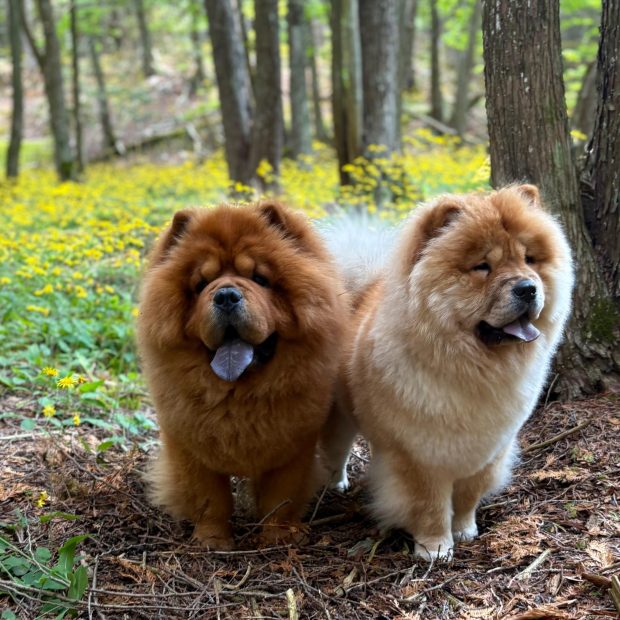
Our lovely photo is provided by Elizabeth McCall McElroy