The word, ‘flocks’ shows up in many breeds standards, not surprisingly most of them herding or Livestock Guardian breeds where flocks refers to their charges. But only two breed standards mention flocks as a description of the breed’s coat, and one of them might surprise you because it is neither a herding breed nor an LGD breed.
We’ll build a little suspense by first talking briefly about the breed in which flock is a well known attribute — the Bergamasco.
The Bergamasco has three distinct hair types in the same coat, and they don’t mix evenly across the dog’s body. The undercoat is short, dense, fine, and oily, and forms a waterproof layer against the skin. Goat hair, conversely, is long, straight, coarse, and wiry; it acts like a stiff framework and keeps things from twisting into a “death spiral” (we added the word “death” for dramatic effect). Finally, the dog’s woolly outer coat is finer and mats easily. Because the goat hair and woolly outer coat aren’t evenly distributed, the stiff goat hair forms a coarse “mesh,” and the woolly hair weaves through that mesh rather than twisting around itself. The result is a flat, irregular, felted mat — the famous “flock” — that is wider at the base, tapers toward the tip, and then may even fan open, rather than a round rope.
It is nothing like, say, a Puli’s coat because that breed’s double coat (a wavy or curly outer coat and a soft, wooly and dense undercoat) mats together to form cords as the dog grow into adulthood and the coat is allowed to develop naturally. That said, as we have learned over decades of living with Pulik, coat texture—and the amount of intervention required—can vary from dog to dog.
The Bergamasco coat multitasks. Its flocks protect the dog from harsh weather, allow free movement in an agile breed, and coat volume makes the dog look larger and more forbidding to potential predators. Whatever additional protection that tremendous coat may offer, its practical value is evident in a breed developed to move and guard livestock on rocky Alpine slopes.
Bergamasco flocks are unmistakeable. and you will impress an owner if you refer to their dog’s coat as “flocked” and not corded.
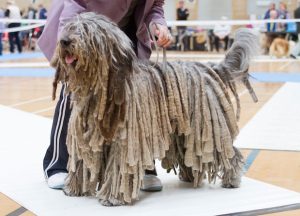
Photo of a Bergamasco by Gardenshed Photography at a dog show in Weston-Super-Mare, England in 2012
Would you be surprised to learn that the other standard to mention flocks is a toy breed?
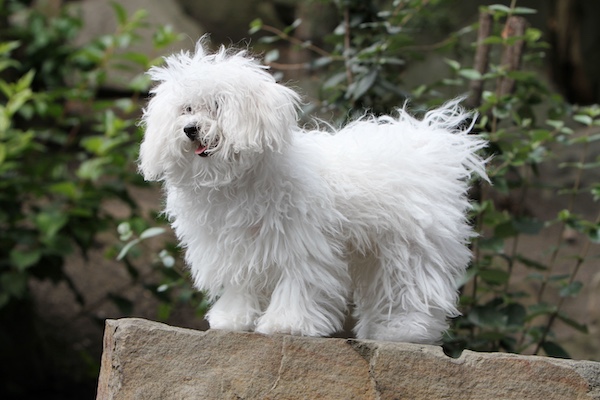
The Bolognese, an enchanting small white breed whose history can be traced back several centuries, was initially bred as a companion dog for nobility and wealthy families, a role it maintains today (though happily across all social classes). The ACK breed standard mentions flocks both in the general description section, and again in the coat section where it reads: Coat: Hair – There are two hair types. One on the body, the other on the ears and tail. Long flocks of wavy open ringlets, which appear as crinkles, are all over the body from the top line to the feet.
The United KC standard reads, “The hair is long and rather fluffy on the entire dog; somewhat shorter only on the muzzle. It lies in flocks, not fringe. The coat is shown natural length, with no trimming except for neatening around the bottom of the feet and for hygienic purposes.”
And the FCI standard writes: “Forms long flocks that have the same texture all over the body, rather off-standing coat thus not falling flat and tight, never shows fringes.
Before we get into the “why” of the flocks, we should mention that the correct structure of the coat is essential because a natural, rustic appearance is super important; Unlike the other white toy breeds, the Maltese and the Bichon Frisé, the coat should look natural and not overly styled. A Bolognese coat has two types of hair: Primary hairs (slightly thicker and coarser) and secondary hairs (soft, woolly, but more prone to breakage). When the secondary woolly hairs gather around the primary hairs, the result is a signature crinkly coat texture. A natural look is so important that the parent club advises to let a Bolognese air dry after a bath rather than blow-drying to maintain its natural texture for shows.
That said, why does a companion dog need flocks? The FCI standard describes its “Utilization” as “Companion dog.” As it: it didn’t herd, guard, cart, pull, hunt, trail, or find.
This, dear reader, is one of those rare occasions when our favorite question — why — does not lead to a practical working explanation. In the Bolognese, the flocked coat appears to have been preserved because it contributed to the breed’s distinctive and appealing appearance, not because it helped the dog perform a particular job. Coat length and texture in dogs are influenced by several genes, including genes associated with long hair, curl, and furnishings. But “flocking” is not one simple genetic trait, and the Bolognese’s flocks are not the same physical structure as those of the Bergamasco.
Instead, these two breeds demonstrate how the same word can describe two remarkably different canine coats: one shaped in a mountain dog that moved and guarded livestock, and the other preserved in an ancient companion whose principal occupation was—and remains—being enchanting.
Photo of a Bolognese by Vanessa Grossemy/alamy