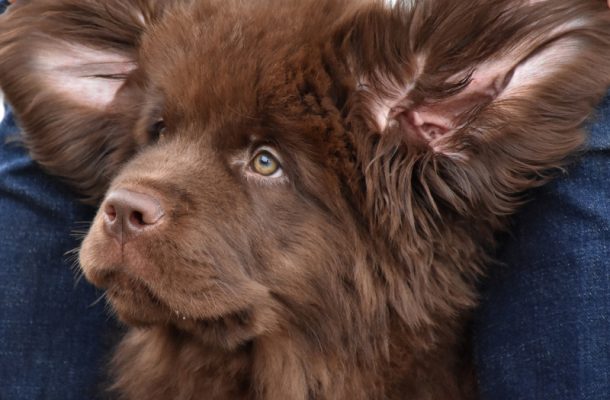
We use this photo of a brown Newfoundland youngster to exaggerate a point: a Newf’s ears lie close to its head. The AKC breed standard describes ears that are relatively small, triangular with rounded tips, and set on the dog’s head level with, or slightly above, its brow. People unfamiliar with the breed’s purpose—a multipurpose working dog capable of draft work on land and natural lifesaving in water—may wonder: what do ears have to do with anything, other than hearing a bag of chips open from another room?
We’ll start by answering two favorite questions on these pages: why and how.
Newfoundlands were bred to be strong swimmers, working in cold, rough water to pull lines, haul nets, or rescue people. Ears that stand away from the head, or hang long and loose as they do in a spaniel, create drag—increasing water resistance and making sustained swimming and powerful propulsion less efficient.
That raises a logical question: why do head-hugging ears work well for a Newfoundland, but not for a water spaniel? The short answer: different jobs select for different ear structures. The Newfoundland’s massive size and need for efficient, sustained propulsion in rough seas favor small, close-lying ears that minimize drag and streamline the head. A water spaniel, by contrast, is smaller and prioritizes ground-scenting for flushing and retrieving upland game alongside water work—its longer, lobular ears help funnel scent particles toward the nose as the dog works cover, making them functionally advantageous for that job despite the modest water-resistance tradeoff.
There’s a second, less obvious benefit for the Newfoundland: for a dog that’s almost constantly in water while working, close-fitting ears also limit water entry into the ear canal and reduce the chance of catching current, waves, or debris during rescue work or diving-type actions.
Head-hugging ears also create a smoother, more hydrodynamic outline for the massive head—and that leads us to how a Newf’s ear set doubles as a proxy for correct skull and head proportions. In the standard, “blending with the head” describes correct placement relative to the skull’s width and the head’s overall shape. Anecdotally, breeders and judges often note that a dog with the right ear set also tends to show the broader, well-balanced head the standard calls for—so ear set can function as one outward sign, among several, that the rest of the head is built correctly for the job.
In a conformation ring, “spaniel-like” ears are the giveaway: loss of the clean triangular outline as length increases past correct proportion, confirmed by a failed reach test.
Wait, what? Reach test?
In a “reach test,” one folds the dog’s ear forward to see that the tip should land at, not past, the inner corner of the eye (this test applies to adults only, since ear leather outgrows the skull in puppies). A judge will also separately check for proper “blend” with the head—a distinct diagnostic from length. Blend is about whether the ear reads as part of the skull’s outline (flat, close, following the cheek curve) versus flaring away from it. This is most visible from the front or rear rather than in profile, and should be checked in both alert and relaxed carriage, since an ear can blend well when relaxed but flare away the moment the dog perks up.
A Newfoundland’s ears are proof that even a giant breed can carry a small, subtle, but highly functional detail.
Image of a brown Newfoundland pup by Dejavu Designs/Dreamstime