When is it OK to tell an adult male that he is growing peach fuzz instead of real, manly hair?”
When he is an American Hairless Terrier—and the hair in question is vellus.
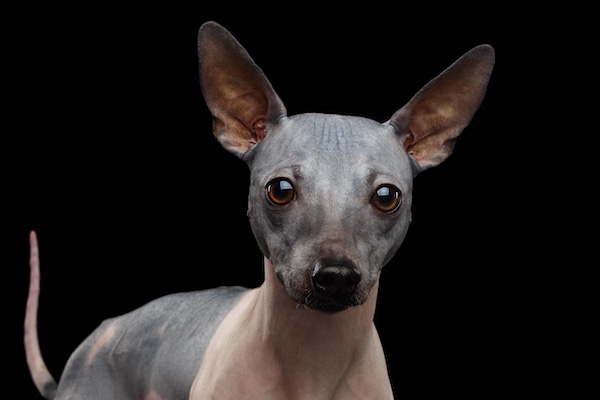
Among the AKC’s current breed standards, the American Hairless Terrier standard is the only one to use the word vellus. It appears in the description of the mature hairless AHT: “Short, very fine (vellus) hair may be present on the body.”
That parenthetical word matters. Vellus is the dermatological term best known for the short, fine, usually lightly pigmented hair humans casually call peach fuzz. It is much finer than the coarse, conspicuous hair classified as terminal hair in people—or guard hair, to use the language of canine coats. The AKC standard is not saying that a mature hairless AHT may grow a sparse but otherwise ordinary coat. It is allowing for extremely fine residual hair that does not alter the dog’s essentially hairless appearance.
More than a bit of unusually precise wording, vellus also provides a clue to the biology that distinguishes the AHT from the other hairless breeds.
Hairless AHT puppies are not born completely naked. They arrive with a soft, vestigial birth coat that generally covers the body. That coat gradually disappears, and the puppies should be hairless by approximately eight to ten weeks of age. A mature dog may retain whiskers, guard hairs on the eyebrows and muzzle, and the permissible layer of very fine vellus hair.
In other words, the AHT forms hair follicles and produces a coat before losing most of it. Its hairlessness is a postnatal process, not simply the absence of hair from the beginning.
Researchers have traced the trait to a four-base-pair deletion—TTAG—in exon 4 of SGK3 on canine chromosome 29. The deletion shifts the gene’s reading frame and is predicted to disrupt normal SGK3 function. Hairlessness is autosomal recessive: a dog must inherit the mutation from both parents to be hairless. Dogs with one copy are coated carriers, while dogs with no copies are coated and clear.
SGK3 is involved in postnatal hair-follicle development and cycling. Its precise actions in canine skin are still being studied, but the AHT phenotype is consistent with that role: the puppy produces an initial coat, then loses it as normal hair production fails to continue. Importantly, AHT hairlessness is not associated with the characteristic dental abnormalities or reduced fecundity seen in the older hairless breeds. (our source: Parker et al., 2017; UC Davis Veterinary Genetics Laboratory)
The Xoloitzcuintli, Chinese Crested and Peruvian Inca Orchid become hairless through a fundamentally different genetic pathway. Those breeds share a seven-base-pair frameshift duplication in FOXI3, inherited as an autosomal semidominant trait. One mutant copy produces the hairless phenotype. Two mutant copies are considered embryonic-lethal, based on the absence of living homozygotes and the breeding ratios observed in these dogs.
FOXI3 is a transcription factor expressed in developing hair and teeth. Its role is more specific than the general observation that both structures arise from ectoderm: altered FOXI3 function directly disrupts ectodermal appendage development and has been linked to missing teeth, abnormal tooth shape and reduced cusp formation. Dental differences are therefore biologically tied to hairlessness in these breeds and are accommodated in their standards rather than treated like ordinary dental faults. (and since you’re wondering, our source is Drögemüller et al., 2008; Kupczik et al., 2017)
Every living FOXI3-hairless dog is heterozygous—one normal copy and one mutant copy. A hairless AHT, by contrast, is homozygous for its recessive SGK3 mutation and is fully viable. The breeds may share a naked silhouette, but genetically and developmentally they arrive there by different routes.
That difference is also reflected in the language of their standards. The Xolo, Chinese Crested and Peruvian Inca Orchid standards describe features such as sparse hair, furnishings, crests, plumes or permitted areas of hair growth.
None uses vellus.
The AHT standard uses the word to distinguish permissible peach fuzz from the return of a true coat in a breed whose follicles produced hair at birth and then largely stopped doing so.
So vellus isn’t decorative vocabulary, and it is not a pretentious word-substitute for “fuzz.” It is a precise word doing a precise job. It describes what may remain on the skin of a mature hairless AHT while quietly pointing toward the postnatal biology that separates this breed from every other hairless breed in the AKC world.
The next time an adult male AHT sprouts a little peach fuzz, there is no need to protect his dignity by calling it a coat. His breed standard—and his genetics—have already given us the better word.