The Grand Canyon has hired a Catahoula.
More precisely, Grand Canyon National Park has added one to its wildlife-management team—and Blue’s assignment is not fetching sticks or posing for vacation photographs. Her job is to persuade elk and bighorn sheep that visitor centers, campgrounds, hotels and busy roadways are not suitable places to settle down.
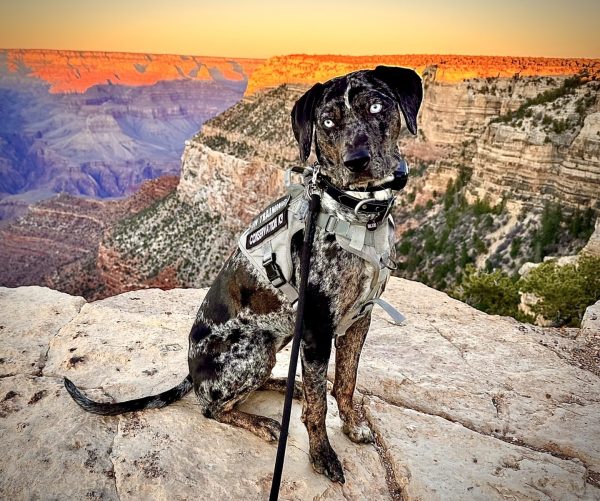
Blue officially reported for duty in May 2026. The National Park Service describes her as a certified Catahoula Leopard Hound; the breed is more commonly registered as the Catahoula Leopard Dog—or, in the United Kennel Club, the Louisiana Catahoula Leopard Dog.
Whatever name one uses, this is a breed that understands work.
At the Grand Canyon’s South Rim, some elk and bighorn sheep have become a little too comfortable around people. Developed areas can offer water, shade, landscaping and food waste, while also seeming safer from natural predators. Animals may linger near buildings, walk along roads, block traffic or approach visitors. That familiarity is not necessarily good for the wildlife—or for humans who forget that an elk is not a big doggie. Encounters become especially risky during spring calving and the late-summer rut.
Enter Blue.
Working on leash with wildlife biologist Brady Dunne, Blue uses controlled barking and herding pressure to encourage an animal to leave a designated area. She is not turned loose to pursue wildlife, and she neither bites nor makes physical contact. Once the elk or sheep moves beyond the exclusion zone, Blue’s work stops.
Think of it as a carefully supervised canine conversation: “Lovely to see you, but you cannot stay here.”
The method takes advantage of a response already built into wild animals. A dog’s presence can resemble the pressure of a natural predator, making developed areas feel less inviting. The objective is not to terrify the animals or drive them great distances. It is to interrupt an unhealthy habit and encourage them to return to more appropriate habitat.
Blue’s breed makes her an intriguing choice for the work. The Catahoula developed as a versatile American stock and hunting dog, valued for endurance, agility, intelligence and the ability to influence the movement of animals. These dogs were expected to think while working, cover difficult country and remain serious about the task at hand.
Those same qualities now have a decidedly modern application at one of America’s most famous national parks.
Blue is part of a three-year pilot project supported largely by the Grand Canyon Conservancy. This is not simply a matter of sending out a dog and assuming the plan works. Park biologists are collecting evidence.
In the fall of 2025, staff fitted nine habituated elk and five habituated bighorn sheep with radio collars. Their movements can now be compared with more than 15 years of wildlife observations and records of emergency responses. Researchers will be able to study whether Blue’s presence changes where the animals spend their time and whether human-wildlife conflicts decrease.
The park is also addressing the things that attract wildlife in the first place, including leaking water systems, unsecured waste and certain landscaping practices. Blue is one part of a larger effort—and visitors have responsibilities, too. Feeding, approaching or attempting to move wildlife remains both unsafe and inappropriate. Blue is a trained professional working under direct control. Vacationers are not honorary members of her team.
The project was inspired in part by wildlife-shepherding work at Glacier National Park. Its arrival at the Grand Canyon gives the Catahoula another fascinating line on an already varied résumé.
There is something particularly satisfying about seeing a traditional working talent applied to conservation. Blue is not being asked to become something other than a Catahoula. The very instincts that once helped dogs manage livestock across demanding country are being directed toward helping wild animals remain wild.
That may be the most important part of Blue’s job. She is not merely moving elk and bighorn sheep away from people. She is helping restore a little distance—and in a national park, respectful distance is one of the kindest things humans can give wildlife.
Photo of Blue, Grand Canyon National Park’s conservation K-9. Photo: National Park Service.