Many donations come with strings attached, and if we think the “small print” is a modern phenomenon, think again. Back in 1919, Scottish engineer and building contractor James Cowan Smith left the National Galleries of Scotland £52,257(almost $80,000 back then) —a very substantial fortune intended to help the gallery acquire important works of art.
There was, however, a catch.
Cowan Smith’s gift came with the condition that the portrait of his beloved Dandie Dinmont Terrier, Callum, be kept on permanent display.
And here, readers are thinking, “And the problem was?????”
Callum had been painted by John Emms, the English artist celebrated for his dog portraits—especially hounds and terriers. Shown in profile on a stone step, Callum stands proudly over a deceased rat at his feet. We don’t have permission to reproduce Emms’s 1895 portrait of Callum here, but you can see it here. What is pretty important about the painting is that the dog isn’t an accessory to someone else, he is the focal point.

Bless him, but Cowan Smith also remembered his surviving Dandie, Fury. His will directed that his coachman, Arthur Wing, receive five shillings each week to provide for Fury to ensure the terrier’s future. Hat tip to a man determined to settle his affairs properly and include his dogs before turning his attention to Scotland’s artistic future.
And what a future his bequest helped create.
Over the following century, the Cowan Smith’s endowment enabled the National Galleries to acquire more than 40 paintings, drawings and prints by important artists. Their names include J. M. W. Turner, Francisco de Goya, John Singer Sargent, John Constable, Peter Paul Rubens, Thomas Gainsborough and Diego Velázquez. Scotland had obtained works by some of the greatest names in European art—and it was a Dandie Dinmont Terrier who retained his promised place among them.
In April 2019, the National Galleries of Scotland marked the centenary of James Cowan Smith’s bequest by welcoming two Dandie Dinmont Terriers, Rupert and Freya, to visit Callum’s portrait with curator Charlotte Topsfield. You can read more about this here.
Callum is not the breed’s only important connection with Scottish art. At The Haining, a historic estate in Selkirk, a life-size bronze honors Old Ginger, the dog recognized as a foundational sire behind today’s Dandie Dinmont Terriers. Born there on June 4, 1842, Old Ginger was commemorated exactly 175 years later when his statue rendered by Alexander Stoddart, then the Queen’s sculptor, was unveiled on June 4, 2017. The bronze stands beside the surviving kennels in which Old Ginger was born. Those kennels were restored and converted into a Dandie Dinmont Discovery Centre, making The Haining one of the rare places where a breed’s ancestry, architecture and public art occupy the same ground.
For a small and increasingly rare terrier, the Dandie Dinmont has left a remarkably large mark on cultural history. One Dandie stands in bronze near the kennel where he was born. Another gazes from a painting whose permanent display was made a condition of a fortune.
We don’t think it’s hyperbole to say that a Dandie Dinmont Terrier helped build Scotland’s national art collection—and ensured that one of its most faithful exhibits would always have four short legs and a topknot.
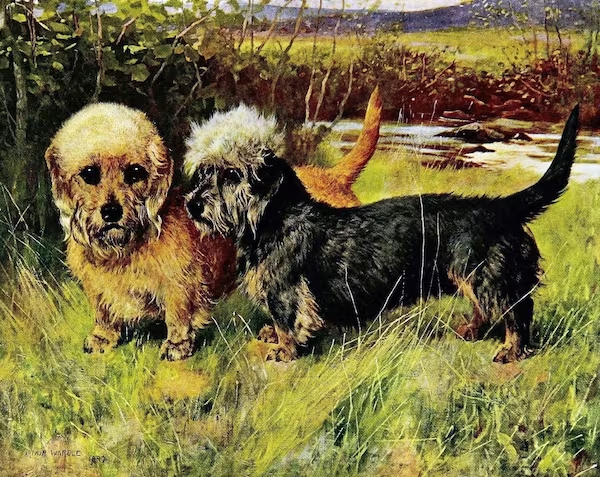
Image of Dandie Dinmont Terriers was released by Karen Arnold under a Public Domain license.