Provocative statement ahead: We don’t care which breed it is, but chances are good that if it’s a long-coated breed, someone, somewhere, has put its head coat in a ponytail at home. As Puli owners for decades, we’ve put not only our dogs’ head coats in ponytails, but just about every other part of their coats as well. The best way to keep a corded show coat clean is to never let it get dirty—and that means tying it up. But there is another reason to tie up head coat regardless of breed, and that’s to see those marvelous eyes.
Here’s another provocative statement: Several AKC Toy Group breeds are shown with their head coats tied up or styled into a topknot in a show ring—but only one has a breed standard that uses the word “ponytail,” and implicit in that description is that the dog appears in the conformation ring wearing one. Can you name it?
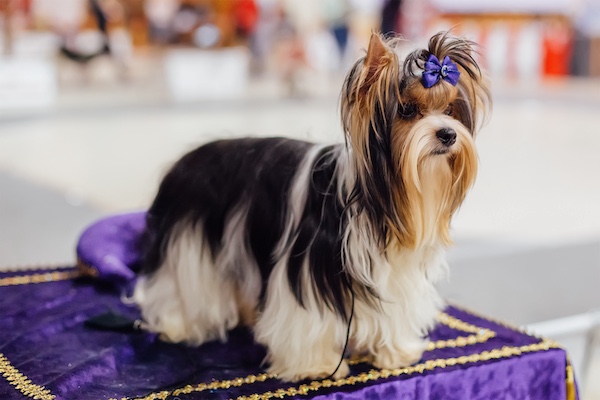
From the first line of the Biewer Terrier standard under General Appearance: “The Biewer Terrier is an elegant, longhaired, tri-colored toy terrier with a distinctive, breed signature ponytail.”
And curiously, in this breed, elaborate head styling is penalized. Again from the standard: “Eliminating Faults – Head falls that display ratting, teasing or roll overs common to other breeds.” Earlier AKC wording singled out topknots by name. Only the Canadian Kennel Club standard still names topknots.
So why would a breed whose standard calls for a ponytail penalize fancy head styling? Because in the Biewer, the ponytail isn’t just a handy way to keep hair out of the eyes. It’s part of breed type. The Biewer Terrier Club of America’s judges’ guide calls a simple, single head fall a hallmark of the breed. It labels ratting, teasing, and roll-overs “artificial grooming.” A built-up head fall may be exactly right on another breed, but on a Biewer it replaces the breed’s own signature look with someone else’s. That’s why the standard takes it so seriously, severely enough to eliminate a dog from competition. The current standard states the ideal plainly: the head fall is “tied in a single fall, finished simply and adorned with a single bow.”
Puppies get a little understanding. The earlier AKC standard allowed a puppy’s ponytail to sit “a little lower on the head” to gather up the short hairs that haven’t caught up with the rest of the coat. The Canadian Kennel Club standard still allows this, placing it on the forehead. It’s a practical allowance, not a license for architecture.
This is where experience shows. Owners and handlers who show Biewers know where the ponytail belongs on an adult, when a puppy’s can sit a little lower, and how to keep it simple. The ponytail is the signature; those marvelous eyes are the bonus.
Photo of Biewer Terrier by Mulderphoto/AdobeStock