
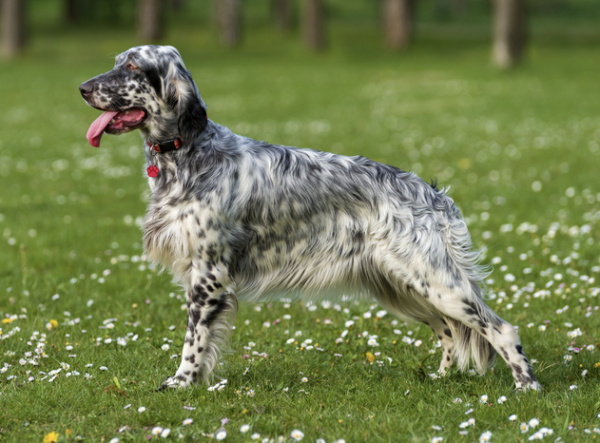
Why is it called “blue” belton when the markings are black?
For new readers, belton is the English Setter’s signature coat pattern: a white coat flecked with small spots of color, in blue belton (black flecks), orange belton, lemon belton, or liver belton (brown flecks). In this post, we focus on the blue belton.
Look closely at a blue belton English Setter and you’ll see a white dog sprinkled with black hairs. Step back, and those black hairs blend into the white until the coat takes on a soft blue-gray cast. The UK’s Royal Kennel Club puts it plainly: “Black and white (blue belton).” No blue hair and no dilute gene, just an old dog fancier’s word for how black and white look together, the same reasoning behind the blue roan Cocker Spaniel.
Fanciers have long used “blue” for an impression rather than a pigment.
Merriam-Webster defines blue roan as a color “produced by mingling of black and white hairs,” and the dog world applies the same idea to blue roan Cockers and blue merles. Geneticists, however, use “blue” for something else entirely. A genetically blue dog has inherited two copies of the dilute variant of the MLPH gene, which reduces black pigment to what researchers describe as “a metallic grey-blue.” A blue belton has no such dilution. Every one of its dark flecks is full-strength black. The blue exists only in the eye of the beholder, which is exactly where the old breeders meant it to be.
So how does a setter end up wearing black flecks on a white coat? It takes several genes working in layers, and it helps to think of it as a canvas and a paintbrush.
The canvas is the white, the paintbrush is ticking, and the paint is the pigment color. Let’s get into it.
The canvas is the white. White markings in dogs are primarily controlled by the gene MITF, at what geneticists call the S, or spotting, locus. Where white spotting takes effect, the skin and coat develop without pigment, leaving a blank canvas. On its own, this would produce a white dog with, at most, a few solid patches.
The paintbrush is ticking. Ticking puts small spots of color back into areas that would otherwise stay white. It can only show where there is white to work on. On a solid-colored dog, ticking is invisible even if the genes for it are present. This is also why English Setter breeders aren’t surprised by litters that look nearly white at birth. As far as we know, some notice that puppies destined to be ticked or roan are born with clear white markings, and the flecks fill in over the first weeks of life.
The paint is the pigment color, and this is what separates the beltons from one another. Blue beltons fleck in black. Liver beltons fleck in brown, the result of recessive variants of the TYRP1 gene that turn black pigment brown. Orange and lemon beltons fleck in the red-yellow pigment pheomelanin, the color dogs produce when they inherit two copies of a recessive MC1R variant that blocks black pigment in the coat. The tricolor, blue or liver belton with tan, adds tan points governed by the agouti gene series.
The gene behind the paintbrush is where the science gets interesting, and still unsettled. In 2021, two independent research teams pointed to the same region of canine chromosome 38, near a gene called usherin (USH2A). A University of Sydney-led study of English Cocker Spaniels and English Springer Spaniels found three versions of this region acting as a series: one for clear white, one for ticked, and one for roan, with ticking dominant over clear. The authors were careful to say this is not simple single-gene inheritance and that other variants remain to be found. A second study, from Embark Veterinary and published in PLOS ONE, identified an 11-kilobase duplication within USH2A that was strongly associated with roaning and acts as a dominant trait. That same study found no strongly associated marker for ticking. The three English Setters in its data did not carry the roan duplication.
That last detail matters. The English Setter standard describes markings that range “from clear distinct flecking to roan shading.” The breed’s “roan” is a description of how dense the flecking looks, not proof that a setter carries the genetic variant researchers call roan in spaniels and pointers. English Setters were not among the breeds studied in the spaniel research, and the exact variant behind belton has not yet been confirmed. Breed people describe belton with confidence; geneticists are still working out its molecular address.
What isn’t in question is the name. The FCI Standards Commission notes that “belton” is the customary term for the breed’s distinctive ticking, that Belton is a village in Northumberland, and that the term was spread through Edward Laverack’s book on the setter. Laverack’s influence on the breed was so great that the word outlived its village origins to become one of the most recognizable color terms in the dog fancy.
So the next time someone asks why a black-and-white dog is called blue, the answer is that breed people named it for what they saw from across a field, and science has never needed to correct them.
Image: Our photo of a blue belton English Setter by Mdorottya/dreamstime was chosen to illustrate color not conformation