If you don’t know Pekingese history, you may never have heard of “The Pearls.” In the Peke world, almost everyone has, along with the woman whose name is on it.
The full title is “Pearls Dropped from the Lips of Her Imperial Majesty Tzu Hsi, Dowager Empress of the Flowery Land.” Each part of that title means something. “Flowery Land” was a 19th-century Western name for China. It came from the Chinese character hua, which can mean “flower” but in China’s name stands for a splendid, flourishing culture. “Dowager Empress” refers to the widow of an emperor, and Tzu Hsi (Cixi, 1835–1908) was one of the most powerful in China’s history. She began as a concubine of the Xianfeng Emperor and bore his only son, and after the emperor died, she worked her way up to became China’s de facto ruler and held power for nearly 50 years, ruling as regent from 1861 to 1908.
The Dowager Empress matters to Peke history because she was the breed’s most famous patron. The AKC notes that she bred Pekingese in her royal kennel, along with Pugs and Shih Tzu. Accounts of her kennel’s size vary widely. Der Ling, a Manchu nobleman’s daughter who served at her court, wrote that the empress kept more than 20 dogs, with a bamboo villa for them and four eunuchs to tend them. A book published by Beijing’s Palace Museum puts the number at more than 1,000 dogs, many of them Pekingese. Her favorite was Hai Lung, whose name means “sea otter.” When she fled Beijing during the Boxer Rebellion, she took Pekingese with her on sedan chairs.
By then, the West had already become enchanted with the breed. In 1860, Anglo-French forces sacked Beijing’s Old Summer Palace and took Pekingese along with thousands of other treasures. Captain John Dunne of the 99th Regiment gave one of them to Queen Victoria, and she was named Looty. Tzu Hsi later gave Pekes to British and American visitors and diplomats, which, as sinologist Don J. Cohn notes, added to the excitement surrounding the breed in the West. Fanciers who owned these dogs wanted an imperial story to go with them, and “The Pearls” gave them one.
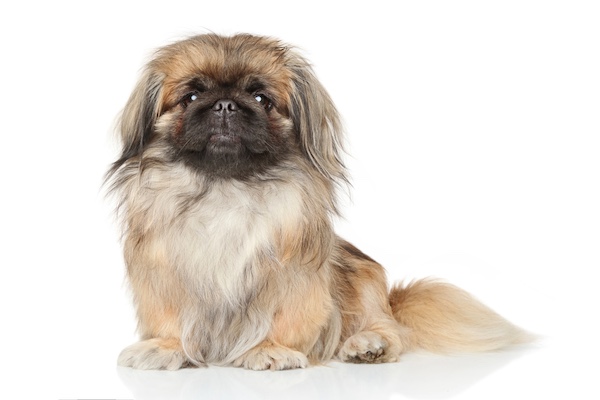
“The Pearls” is a short list of rules describing the ideal palace dog, and each one begins with “Let” ((find the rules on page 5 of this document). “Let the Lion Dog be small; let it wear the swelling cape of dignity around its neck.” Its ears should be “set like the sails of war junk,” and its forelegs should be bent “so that it shall not desire to wander far, or leave the Imperial precincts.”
The list covers color, temperament, and diet, including shark’s fins and curlews’ livers. It ends with a warning to the owner: “if it dies, remember thou too art mortal.”
As if a Pekingese would ever let us. But we digress.
Whether Tzu Hsi wrote any of it is uncertain. The AKC says it isn’t clear whether the list is authentic or “the florid prose of some later fancier.” The text appears to have been in the possession of the first Pekingese Club. Mrs. Ashton Cross published it as a pamphlet, and Smythe included it in her 1909 book, “Pekingese.” The Morgan Library & Museum calls it “unprovenanced.” A study in the Journal of British Studies notes that its stereotypes match late-19th-century Western guides to “Chinese character” and the pseudo-Chinese fiction popular at the time. That may also explain one of its more startling rules (and a personal favorite): “let it learn to bite the foreign devils instantly.”
But then there’s the line that stops many readers (ok, it was us): “Let it venerate its ancestors and deposit offerings in the canine cemetery of the Forbidden City on each new moon.”
As a rule, when dog owners see “deposit” and “dog” in the same sentence, our minds go somewhere very different from what the line actually means. Rest assured, readers won’t need a plastic baggie to read on.
The “offerings” are tributes, and the line borrows a real Chinese practice. Families traditionally made offerings to their ancestors on the first and fifteenth days of each lunar month, dates that fall roughly on the new moon and the full moon. The imperial court made offerings at royal tombs on those same days. The Qing imperial family, Tzu Hsi’s own dynasty, held its private rites in the palace temple on the first and fifteenth of each month. The writer gave that rite to the dog, casting the Peke as a dutiful member of the imperial household who honors its lineage the way a filial son would. For Western fanciers building a breed, a dog that honors its ancestors is a dog with a pedigree worth honoring.
The cemetery itself, we found, is harder to pin down. We found no expert source confirming that a dog cemetery existed in the Forbidden City. Pets did sometimes receive graves among China’s elite. Katharine Carl, the American artist who painted Tzu Hsi’s portrait, described small tombstones marking a prince’s favorite dogs and horses at his residence. That was a prince’s grounds, though, and not the Forbidden City.
None of this takes away from what “The Pearls” achieved. Cohn writes that it has inspired generations of Pekingese fanciers, “bestowing on the breed an instant imperial pedigree.” The AKC credits it with inspiring the breed’s Western standards. Judge Andrew Brace still quotes this line in his presentation on judging the breed, in a version that reads “dog cemetery.” He tells judges that studying “The Pearls” should remind them of the long history and tradition behind the Pekingese.
Its author may never be known for certain, but its influence on the breed is clear.
As an aside, it is a failing of many dedicated dog owners to resolve to own every single book written about their breed. While obscure, A Chinaman in Sussex and Strange Bedfellows might just belong on the shelf of one of our Pekingese owning readers.
Photo by FotoJagodka/Deposit