It came as a bit of a surprise to realize that after a decade of writing about purebred dogs here, there are still breeds we’ve never properly introduced. One of them is the Saarlooswolfhond, better known in English as the Saarloos Wolfdog.
The story begins with Leendert Saarloos. Born in Dordrecht, the Netherlands, in 1884, he spent years at sea as a ship’s cook until his congenital deafness kept him on shore. A lifelong lover of nature and of dogs, Saarloos devoted himself to the breed he admired most once he was back on dry land, the German Shepherd Dog.
By the early 1930s, he believed the German Shepherd was in trouble. In his view, dogs had become “too humanized,” and the Shepherd had grown too nervous for police work. He didn’t believe any modern breed could put back what was missing. What he wanted were the wolf’s calm nerves, strength and stamina, combined with the Shepherd’s drive to work.
So he went straight to a source, and here the facts we’ve gleaned get a little unclear. The Rotterdam Zoo, then the Rotterdamsche Diergaarde in the heart of the city, supplied a she-wolf he named Fleur, whom he bred to his own Shepherd, Gerard van Fransenum, a dog of old Prussian lines. Breed histories disagree on the date. The FCI and UKC give 1932, but one of our favorite writers, Dutch dog historian Ria Horter, writes that Saarloos’s first female wolf died before she could be bred in 1935, and that his first litter, born in 1936, didn’t survive.
Our knee-jerk reaction, though, was surprise that a zoo agreed to the arrangement at all. The sources don’t even agree on what kind of deal it was. Horter says the wolf was “donated,” a Rotterdam news outlet says she was lent, and the Dutch breed club AVLS says only that she was “obtained.” One German breeder’s history adds that the zoo later supplied more wolves, so the arrangement apparently continued. As to why, no one seems to have recorded it. We can only note that the zoo was reorganized in 1932 and had been struggling financially, so parting with a wolf may not have been a hard decision. Conjecture only.
The police dogs never happened. The wolf’s flight instinct kept coming through, and his dogs were more likely to run from trouble than toward it. Then, during the Second World War, Saarloos discovered almost by chance that this same caution made his dogs good guides for the blind. He opened a guide-dog training school and called his dogs European Wolfdogs. He selected for character, not looks, and reportedly said of appearance, “They’ll be beautiful anyway.” Between 1936 and 1963 he used at least four, and probably five, female wolves. As far as Horter could find, he never again bred in a German Shepherd or any other breed.
Recognition was another matter. In 1942 the Dutch Kennel Club judged his dogs not uniform enough and not inclined enough to serve people, and it turned him down. In 1943 it wrote that his dogs did “not possess hereditary characteristics that make them into a separate breed.” Saarloos responded by selecting even more strictly, and he kept a stud book from his very first litter, so every dog he bred had a four-generation pedigree. But when he tried again after his last wolf breeding in 1963, the club said no a second time, “not because of the breed itself.” He insisted on owning every dog he sold and on being the only person allowed to breed them. A breed controlled by one man couldn’t be recognized.
It took his death in 1969, and a dwindling population, to break the stalemate. Forty of his dogs attended his funeral. With the breed’s future in danger, enthusiasts formed a breed club and put his dogs forward for recognition, among them G. de Josselin de Jong and A. Brooijmans. As a compromise, Saarloos’s heirs joined the new club’s committee and agreed to give up their ownership rights. By then the breed had more than 30 years of selection and recorded ancestry behind it, and it was finally in many hands. On July 5, 1975, the Raad van Beheer (the Dutch Kennel Club) recognized the breed and named it the Saarlooswolfhond in his honor. In the words of the FCI standard, “Honour to him to who honour is due.”
As for the breed’s job today, it has none, by design. The FCI says the Saarloos “was not bred with any aim for a particular utilization.” Instead, it describes a faithful companion and house dog that is reserved with strangers. The breed is recognized by the FCI as Standard No. 311 in Group 1, accepted on a definitive basis on November 18, 1981. Dutch breed clubs date FCI recognition to 1977, which may refer to an earlier provisional acceptance. The United Kennel Club recognized the breed on July 1, 2006. In April 2026, the AKC accepted it into its Foundation Stock Service, a record-keeping program that does not count as full AKC recognition.
We’ve read that there is an estimated 5,000 dogs worldwide, and that Saarloos owners tend to know one another. Lisa van Hoof chairs the Belgian breed association, and her Saarloos Daya has appeared in the TV series, Undercover, starring Tom Waes, and in Arcadia. Lisa says the breed will work with people, “but on their terms.” You can see Daya’s Undercover cameo — the 63-second scene, on the Lykos kennel’s Film & TV page here.
In April 2025, Marianne Eggink was named a Knight of the Order of Orange-Nassau for her work with AVLS, a Dutch Saarloos breed club. She was surprised at Rotterdam’s city hall by Koning Horzel, a Saarloos she bred and a descendant of the zoo’s wolf. The breed had come full circle, back to the city where Fleur once lived.
The Dutch Kennel Club recognized the Saarloos on July 5, 1975. The FCI followed and places it in Group 1, Sheepdogs and Cattle Dogs. The FCI dates its definitive acceptance to 1981, though Dutch breed clubs say the FCI first accepted the breed in 1977. The UKC added it to its Herding Dog Group in 2006, while the AKC accepted it into the Foundation Stock Service in April 2026. While not full recognition yet, the AKC has already placed the breed in the Herding Group when it’s time.
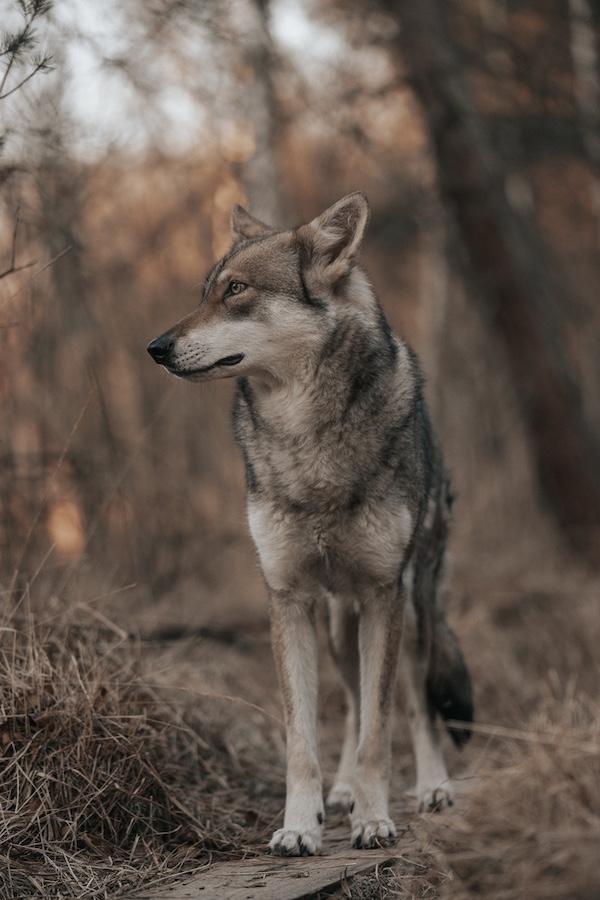
Image of a Saarloos Wolfdog by wirestock_creators/DepositPhotos