
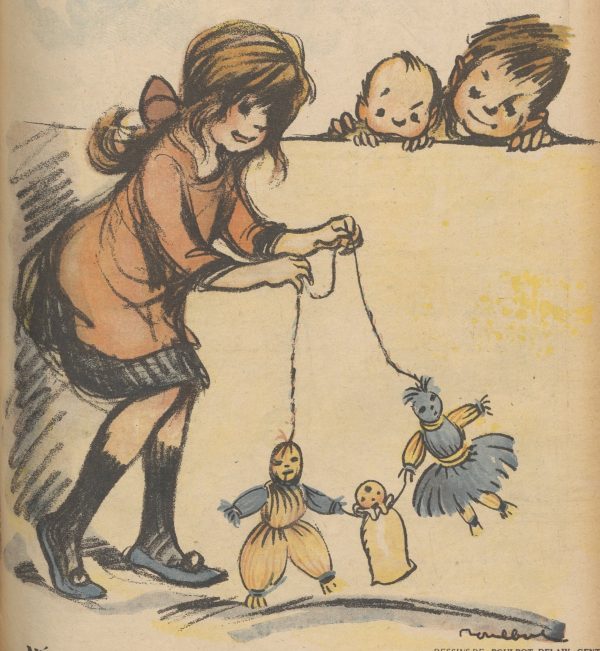
In the spring and summer of 1918, Paris was a city under fire. German bombers and long-range artillery could now reach the capital, and Parisians, worn down by four years of war, reached for whatever comfort they could find. For many, that comfort was small enough to pin to a lapel: a pair of tiny dolls, a boy and a girl, wound from scraps of yarn and joined by a single thread.
The charms came with rules. You couldn’t make one for yourself, and you couldn’t buy one. It had to be given to you, and the thread linking the two figures could never be broken. One observer in Paris that July warned that if you had one without the other, “the charm is broken.”
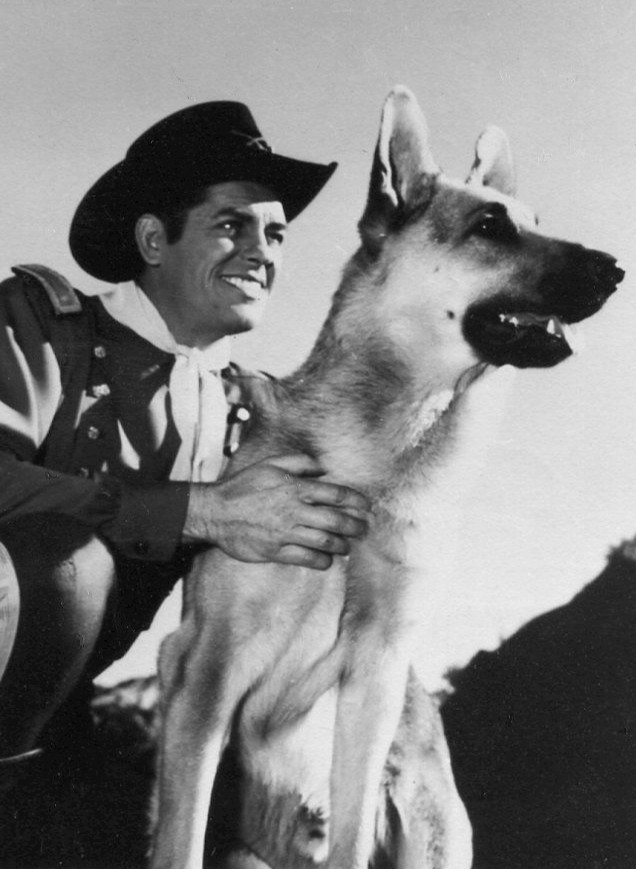
Photo of James Brown as Rip Masters and Rin Tin Tin from a postcard Brown sent to a fan of the television show. By James Brown – eBayfrontback, Public Domain,
No one knows for certain who made the first yarn pair. Stories went around that they were named for two children a French regiment found sheltering on an abandoned farm, that a seamstress at the couture house of Madame Paquin made them for a friend, or that they honored a young couple who survived a bombing at a Paris railway station. The Smithsonian considers the regiment story the least likely of the lot.
What is documented is that the pair began life before the war as porcelain dolls designed by Francisque Poulbot, the illustrator beloved for his drawings of the street children of Montmartre. Poulbot wanted French children to have an alternative to the German toys that filled French shops. By Christmas 1913, his dolls were for sale in Paris department stores, including the Grands Magasins du Louvre and La Samaritaine. Sadly, they were a commercial flop, and they were on the market for only about a year before the war halted production.
The war brought them back to life in yarn. Young women gave them to sweethearts leaving for the front, and village children pressed them into the hands of passing soldiers. Pilots especially treasured them, and many American servicemen carried them home. Even Van Cleef & Arpels made enamel-and-gold versions in August 1918.

These dolls had names, and while you may not take particular notice of one of them, Nénette, you will definitely know the other: Rintintin, later rewritten as Rin Tin Tin. Both names were given to a pair of German Shepherd puppies found by an American corporal, Lee Duncan, in a bombed-out German army kennel in Lorraine in September 1918. Duncan kept a male and a female, and the male went on to become one of Hollywood’s first great canine stars.
There’s one last twist. Poulbot’s Nénette was the boy and Rintintin was the girl, their names taken from pet names Poulbot shared with the woman he married in 1914. Somewhere along the way the genders flipped, which means the most famous German Shepherd in film history was named for a little girl.
Photo: “Rintintin and Nénette,” 1918, by Francisque Poulbot. Public domain (CC0) via Wikimedia Commons.