Anyone who has ever hoisted a sail, raised a flag, or pulled up anything heavy knows the magic of a pulley. Run a rope over a wheel, and the same pull suddenly does more work, in a better direction, and with less wear on the rope. Small adults who have no one larger around to help rearrange the garage learn this early.
But did you know that your dog has been using that trick since he took his first steps? He just keeps his pulleys hidden inside his tendons.
His pulleys are called sesamoid bones. Unlike the rest of the skeleton, they aren’t anchored to other bones by ligaments. Instead, they sit inside a tendon or muscle, right where it wraps around a joint. They’re easy to overlook, but they quietly help every stride your dog takes, whether he’s gaiting in a show ring, working a field, or making a beeline for the kitchen when he hears a snack bag being opened.
Veterinary anatomists list three main jobs for sesamoids. They protect tendons where the tendons pass over bony points. They give a tendon more surface to attach to as it crosses a joint. And they redirect the tendon’s pull, so the muscle gets more effective force out of the same effort. In plain terms: less friction, better leverage, longer-lasting tendons.
The best-known sesamoid is one most dog owners have heard of without knowing it belongs to this group: the kneecap. The patella is the largest sesamoid in the body. It sits in the tendon of the quadriceps, the big muscle group on the front of the thigh, and it rides in a groove at the lower end of the thighbone called the trochlear groove. Veterinary surgeons describe the patella and its groove as a pulley system. By holding the quadriceps tendon away from the pivot point of the stifle, the patella gives the muscle a longer lever, so it doesn’t have to work as hard to straighten the leg. The patella also shields the tendon from friction and helps keep the stifle stable.
Then comes the part that we structure geeks love. In a growing puppy, the kneecap helps shape its own groove. As the young dog grows, pressure from the patella against the femur helps the groove develop the depth and width it needs. When that pressure is missing, the groove doesn’t develop properly. That’s form following function, carried out by one small bone. How cool is that?
It also explains why alignment matters so much. The kneecap stays in its groove only when the quadriceps, the groove, and the point where the tendon attaches on the shinbone all line up. When they don’t, the patella can slip out of place, a condition called patellar luxation. A pulley works only when the rope runs straight.
The kneecap has company. Just behind the stifle sit two small sesamoids called fabellae, Latin for “little beans.” We first learned about fabellae when our Puli puppy injured one of his. Each fabella sits in the tendon of one of the two heads of the gastrocnemius. That’s the calf muscle that anchors at the point of the hock and makes up the main part of what’s called the Achilles mechanism. A third sesamoid, the popliteal sesamoid, sits in the tendon of the popliteus muscle near the top of the shinbone, and it shows up as bone in roughly 84 to 94 percent of dogs. Count them up: three hidden pulleys behind the stifle, plus the kneecap in front.
Look at your dog’s feet. Dogs are digitigrade, which means they stand and move on their toes. Each of the four main toes on a front paw has a joint where the long bone of the foot meets the first toe bone. Under that joint sits a pair of sesamoids, and on top sits a single one. That makes eight sesamoids on the underside of each forefoot, numbered one through eight from the inside of the paw to the outside, with the same arrangement in the hind feet. Anatomists class the underside pairs as belonging to the interosseous muscles, but those sesamoids also give the digital flexor tendons a smooth surface to glide over. The interosseous muscles flex those knuckle joints and hold the joint angle while the dog is bearing weight on the paw. And yes, we had to look all that up.
Horse people already recognize the idea. In the horse, the interosseous tendon is the famous suspensory ligament. It runs to the sesamoids at the fetlock and, together with the ligaments below them, forms a sling that keeps the joint from overextending. In the dog, the interosseous structures are muscles rather than a tendon, but the principle is the same: sesamoids help support the very joints a running dog lands on. Readers who followed NPDD’s posts on pasterns and feet now know a little more about what keeps those shock absorbers working.
There’s a dewclaw connection, too. On the inner side of the wrist sits a small sesamoid in the tendon of a muscle named for moving the first digit. That digit is the thumb in people and the dewclaw in dogs. In dogs, the muscle appears to have lost that job and works instead as a stabilizer on the inside of the carpus. A large Ghent University study explains that when a dog turns after a jump or while galloping, the first digit may touch the ground, and this muscle helps protect the wrist from twisting too far. The study examined 743 adult dogs from 115 breeds and found this sesamoid in all but 14 of them.
The same study turned up a fact breeders and rescuers may appreciate. The wrist sesamoid is already present at birth as a nodule of cartilage. It first shows on an X-ray at an average of about 108 days, roughly 15 weeks, and it is fully bone by about 23 weeks. The timing didn’t differ by sex or breed size, so the authors suggest its presence or absence on an X-ray can help estimate a puppy’s age, alongside other signs of skeletal development.
Remember the collarbone? We have written before about the dog’s “floating” clavicle, a small remnant held in place by muscle rather than joined to the skeleton. Veterinary radiologists list that remnant alongside the sesamoids in their guide to small bones seen on canine X-rays. It’s embedded in the brachiocephalicus, the muscle that pulls the front leg forward, at a fibrous seam in that muscle. One veterinary radiology textbook reports the clavicle present in up to 96 percent of large dogs, though figures vary from study to study. In effect, the dog’s collarbone survives as one more bone carried inside soft tissue.
So why should the owner of a family dog care about bones he or she will never see?
For the same reason we always say structure matters. These small bones are part of how a dog moves efficiently and stays sound, and knowing what’s normal can spare an owner some worry. Sesamoids vary from dog to dog. A given sesamoid may be present in one dog and missing in another, some stay cartilage rather than turning fully to bone, and some sit slightly higher or lower than the textbook diagram shows. On an X-ray, the wrist sesamoid has been mistaken for an old chip fracture. In one study, 70 percent of West Highland White Terriers had an inner fabella sitting lower than usual. Researchers believe this is usually a harmless variation that shouldn’t be mistaken for an injury.
Rope, wheel, and a little less wear and tear: the pulley is one of the classic simple machines. Dogs just got there first.
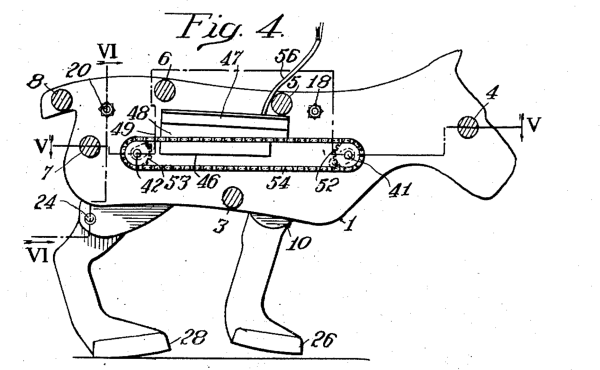
Image: “Walking Figure Toy,” Fig. 4, U.S. Patent 2,638,709, Max C. Mason, 1953. Public domain. Source: United States Patent and Trademark Office.