A Rum Gordon sounds like something one might order at a bar. In fact, we think it should be the name of an adult beverage. Rum Gordons, however, were Gordon Setters named for the Scottish island owned by their breeder, Sir George Bullough.
And these dogs earned their ink. Bullough’s Rum Bess won at Cruft’s in 1902, while the contemporary New Book of the Dog credited her sire, Redruth Colonel, with much of the improvement seen in the “Isle of Rum team.” Walter Baxendale, kennel editor of The Field, singled out Colonel and another Bullough dog, Rhum Captain, as “a type to themselves.”
Their owner certainly had the means to support his enthusiasm for dogs. Bullough inherited Rum from his father, John, in 1891, along with a half-interest in the family’s textile-machinery business. He later commissioned Kinloch Castle, built on the island between 1897 and 1900. The island gave his setters their name. Let’s be frank: the dogs’ successes gave the name a reputation.
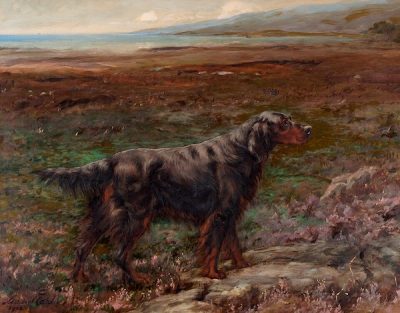
One of those setters also secured a more lasting introduction. In 1902, the celebrated canine artist Maud Earl painted Rum Bess, preserving the image of an individual dog whose name, parentage, and show accomplishments we can still identify today.
Bess was by Redruth Colonel out of Bullough’s bitch Barkeval. Earl depicted her standing in a landscape, her coal-black coat set off by rich chestnut markings. This was no anonymous setter included to make a country scene look suitably sporting. The painting was Bess’s portrait, and Bess had street cred. Art UK’s collection record credits her with first places in two classes at the 1902 Cruft’s International Dog Show.
Her sire’s contribution takes us beyond one successful show appearance. By crediting Redruth Colonel with improvement in the island team, The New Book of the Dog identified him as an influential breeding dog within Bullough’s kennel. That distinction matters: winning with a good dog and producing better dogs are related accomplishments, but they are not the same accomplishment.
So what made Colonel and Rhum Captain “a type to themselves”?
We wish we knew precisely. It’s just the kind of tantalizing remark that makes us want to keep digging. But the passage does not give us enough detail to reconstruct a distinctive Rum type. Baxendale’s admiration is documented; a consistent difference in size, head, coat, or hunting style is not established by that phrase.
There is a similar temptation to imagine the dogs working across their owner’s island and fill in the rest ourselves. But a sporting estate is a setting, not a field record. The sources we have located establish show success and contemporary praise, but not individual field accomplishments for Bess, Colonel, or Captain. Nor have we traced a pedigree connecting them to today’s Gordon Setters. Those are open questions in our research—not evidence that the dogs never worked or that their bloodline died out.
Bess’s later history is easier to follow. Her portrait was purchased as part of the Bullough Estate in 1957 and remains in the Kinloch Castle collection. Whatever else may yet be recovered about the kennel, she has kept her name, her parentage, and her place in its story.
We still think someone should invent the drink. But maybe name it for Bess. She brought attention to the pedigree, the Cruft’s win, and the Maud Earl portrait. The rest of us can bring the ice.
Image of “Rum Bess,”the Gordon Setter, by Maud Earl, 1902. Kinloch Castle collection. Public domain reproduction via Wikimedia Commons