We Puli owners often describe our fully corded dogs as moving like a “hover craft,” but there is another breed in which the word “hover” actually appears in a breed standard.
Enter the Ibizan Hound, whose feet deserve some of the attention usually garnered by those magnificent ears.
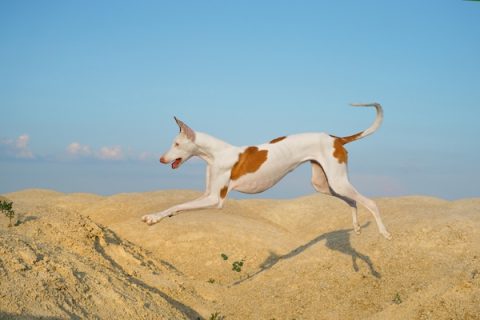
The UK’s Royal Kennel Club breed standard describes the Ibizan’s movement as a suspended trot with a long, far-reaching stride and “a slight hover before placing foot to ground.” Its official glossary makes the instruction more precise: Hover is a slight suspension of the front feet before placement. It even directs readers to the Ibizan Hound. This isn’t a poetic description borrowed by an enthusiastic admirer. It is actual breed terminology.
Nor is it a reference to the Ibizan’s epic jumping ability. We are talking about a dog at the trot, not one launching himself skyward like a missile. The distinction matters because the intriguing part isn’t how high the Ibizan goes, but what happens as his front foot prepares to meet the ground.
Across the “pond” (the Atlantic Ocean, that is), the AKC standard describes “a suspended trot with joint flexion when viewed from the side,” accompanied by smooth front reach and balanced rear drive. The wording differs, but it reminds us to watch the dog’s front action in a conformation ring, not merely his outline as he moves around it.
The American parent club’s judges’ education material supplies additional depth on the movement described in the AKC standard. In its illustrated standard, the Ibizan Hound Club of the United States explains that a rather upright upper arm, combined with a well-laid-back shoulder, produces the characteristic combination of front lift and reach. The club describes a “break at the wrist”—flexion, not an injury—within an otherwise balanced, efficient stride.
Here is where we think an important distinction can get lost. Lift does not mean that the more dramatically a dog picks up his feet, the better he moves. The parent club explicitly states that correct Ibizan action is neither restricted nor hackneyed. The front must still reach smoothly forward, with effective drive behind. This isn’t high-stepping for high-stepping’s sake or dramatic effect. Characteristic movement isn’t an excuse for unsound movement.
But why do we spend any time at all discussing the trot of a hunting hound who can gallop and leap?
Because the hunt is not one uninterrupted sprint. The parent club calls the trot an important “reconnaissance and endurance gait.” It also explains that Ibiza’s rough terrain and bushy vegetation favor a hunter who trots and gallops with lift and can leap. That is a functional explanation for the overall movement style, not proof that the particular moment called a hover evolved to clear a particular rock.
“Hover” sounds colorful, and in fact, almost whimsical, until the parent club puts it in the context of a dog doing a day’s hunting. That small detail of front action becomes something worth looking for—not because it is showy, but because it belongs to the working character of the breed.
Image: Ibizan Hound by Anna-av iStock