Given a Puli’s profuse, floor-length coat, prospective judges often ask their mentors how they’re supposed to discern rear foot movement beneath all those cords. We tell them to watch as the dog moves away: A Puli’s foot should penetrate the rear cords, revealing a good glimpse of the foot pad as they move away. How much of that pad can be seen is also revealing.
It’s not that different for the Coton de Tulear.
Different coat, certainly, but a similar challenge: How do you evaluate what all that hair threatens to hide?
In its supplementary judges’ education guide, Judging the Coton de Tulear, the United States of America Coton de Tulear Club describes a useful clue to rear alignment: the “flash of pad.” The phrase comes from the club’s guidance on evaluating movement, not from the AKC breed standard itself.
The guide explains: “The straight leg will show the pad balanced perfectly in line with front leg placement. Legs that are too close or cow hocked will show the pad at an angle.”
In other words, seeing a pad is only the beginning. How it presents itself matters.
Think of the pad as a little window into the construction above it. The breed standard calls for muscular hind legs and rear pasterns—the section between hock and foot—that stand perpendicular to the ground when viewed from any angle. The club’s supplementary judging guide asks for straight rear legs, neither too close nor too wide, and without cow hocks.
“Straight” here describes alignment, not a rear leg without a bend at the stifle or hock. Viewed from the side, the standard describes an angulated rear assembly. Viewed going away, however, the judging guide asks for a straight line from hip to pad. We’re looking for correctly aligned movement, not a stiff, unbending leg.
When the hocks turn inward and the rear feet turn outward—the arrangement called cow hocks—the pad presents at an angle. Correct structure doesn’t create the flash so much as determine what that flash reveals. Merely catching sight of a pad isn’t enough; its orientation is the useful part of the glimpse.
And no, moving faster doesn’t change the assignment. The Coton’s correct gait is a free-flowing, moderate trot, with its topline held firm. This isn’t about “to the swiftest belongs the prize” let alone sending the dog around at a dizzying speed. It’s about giving the judge an opportunity to see what those feet are actually doing.
For those of us accustomed to looking through a Puli’s moving curtain of cords, the principle feels familiar. Don’t let the furnishings have the last word by fooling your eye.
Watch the Coton going away. Look for the flash. Then pay attention to what it tells you. Unfortunately, photographers underestimate the interest among many dog people in seeing a dog move away, and not just from the side or front.
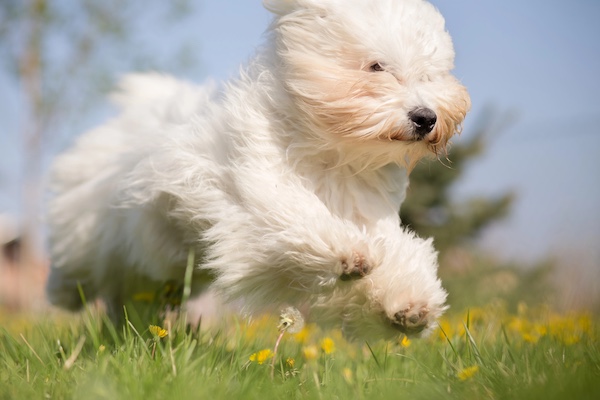
Image: Coton de Tulear by Lunja87/Depositphotos