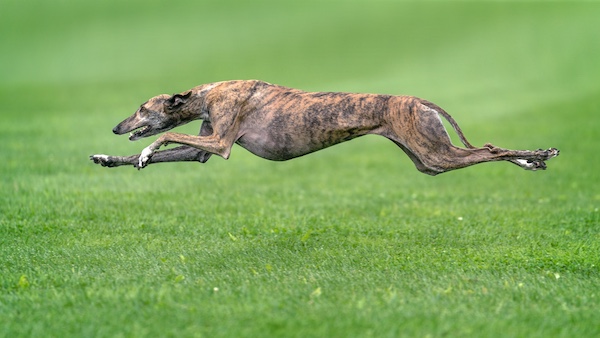
At just over 220 words, the Greyhound has the shortest of all AKC breed standards, so every word matters. The repeated use of the word ‘muscular’ (five times) is a clear signal that this is an attribute the Greyhound must have: A muscular neck, muscular shoulders, a muscular back, a good depth of muscle in the loins, and very muscular hindquarters.
Since math isn’t our strong suit, we consulted an AI to learn that ‘muscular’ appears about 2.27% of the time in the Greyhound’s standard—that’s roughly once in every 44 words.
To our knowledge, no standard calls for a breed to be fat at all costs. A fit dog is a healthy and attractive dog, but why is musculature especially important in this breed? To state the obvious, the Greyhound is a sighthound with exceptional sprinting and acceleration abilities, but it has a highly specialized muscle structure that includes a significant mass of powerful muscles in both its front and rear limbs. The pelvic limb muscles are relatively larger in the Greyhound than in other, less specialized breeds, muscles that generate the substantial extensor moments needed for the breed’s propulsion and rapid acceleration.
In a paper by S. B. Williams, A. M. Wilson, J. Daynes, K. Peckham, and R. C. Payne, we learn that many Greyhound muscles have long fascicle lengths and specialized pennation angles allowing high-velocity contractions and large ranges of limb motion. In simpler terms, this means that many of the Greyhound’s muscles are “built long” and the way the muscle fibers are arranged allows the dog to move his or her legs very quickly and stretch them out far. These unusually long fibers are aligned to work faster and over a greater range of motion—a little like having extra-long elastic bands that can snap back quickly and powerfully. This special design lets Greyhounds run at high speeds and cover a lot of ground with each stride.
In the forelimbs, large muscles also have long muscle fibers enabling them to contract rapidly through wide ranges of motion. They have a critical role in pulling the dog’s body forward and retracting the forelegs quickly during the acceleration phase, one reason the Greyhound has significant propulsion and control.
Near the Greyhound’s shoulder and elbow, some muscles — like the biceps brachii and triceps brachii — cross over two joints instead of just one. These muscles don’t just produce powerful movement, they also help keep the joints steady while the dog is running. This stabilizing, or “stiffening,” effect turns the front leg into a strong, supportive column when it hits the ground, allowing the dog to push off efficiently while protecting the joints from strain.
Meanwhile, the Greyhound’s back legs have big, powerful muscles that straighten the hips and drive the dog forward with a lot of force. Many of these muscles are built with long fibers that let them contract quickly and strongly through a wide range of movement. Some of the muscles and tendons work like springs — they store energy when stretched and release it as the leg pushes off. This spring-like system makes the Greyhound run more efficiently because the dog uses less energy to sprint at high speeds.
Unlike many four-legged breeds that rely on their hind legs for propulsion, Greyhounds maintain nearly equal muscle mass dedicated to movement in both their forelimbs and hind limbs. This balance means that their front legs not only stabilize their body, but actively contribute to forward drive and precise maneuvering—crucial at the high speeds and quick directional changes for which this breed is noted. Overall, the Greyhound’s musculature integrates powerful, fast-contracting muscles with dynamic joint stabilization and efficient energy recycling, enabling rapid acceleration and a top-end speed around 45 mph!
There is another word repeated in this short breed standard. See if you can spot it:
- Head: Long and narrow;
- Neck: Long, muscular;
- Tail: Long, fine and tapering;
- Hindquarters: Long, very muscular and powerful;
We bet it didn’t take you long to spot it!
Being “long” in key body parts like the head, neck, tail, and hindquarters is crucial to the Greyhound’s function as a high-speed sprinter because these extended proportions directly optimize its movement and power. A long, narrow head reduces aerodynamic drag and allows the dog to cut through the air efficiently when running. A long neck provides better balance and helps position the body aerodynamically; coupled with muscular strength in the neck, this supports head control and stabilizes the spine during fast running. Since the tail acts like a rudder for steering and balance during high-speed turns, its long, tapering shape allows precise directional adjustments without adding weight. And finally, long hindquarters increase stride length and help generate the Greyhound’s explosive propulsion. Remember now, the breed’s muscles have long fibers that contract fast and move joints through wide ranges. Add to this hindquarter muscles and tendons that act as springs, while storing and releasing elastic energy, and we have a perfect running machine.
We hope by now, regular readers know the importance we put on the word, “why.” As we’ve said before, breed standards tell us the “what” of a breed, but they don’t always tell us ‘why’ the ‘what’ is important.
Why are musculature and longness important in the Greyhound?
We suspect most of you will think it has to do with racing, and that’s only half the story. Long before Greyhounds were raced for sport, they were used for hunting. There is evidence of greyhound-type dogs existing in the Middle East at least 3,000 years ago, and by the 6th century, Greyhounds had spread to England. By the reign of King Canute in 1014, laws were enacted restricting Greyhound ownership to the nobility, reflecting their special role as elite hunting dogs reserved for kings and aristocrats— and for good reason. The Greyhound was ideally built for the burst-and-chase hunting style favored in medieval hunting: Its powerful, fast-contracting muscles, balanced muscle mass front and rear, long limbs, neck, and streamlined head – these all were crucial for sprinting across diverse terrain in royal hunting grounds.
If you are ever lucky enough to see a Greyhound run, remember: every “long” limb and finely honed muscle tells a story centuries in the making. This isn’t just a fast dog—it’s a living relic of kings, castles, and the ancient chase, purpose-built for the glory of speed and the thrill of the hunt.