
Once upon a time, a long long time ago (in the “dark ages” before 1999), the Teddy Roosevelt Terrier was known as the Type B or “bench-legged” Rat Terrier. These were Ratties that expressed the short-legged gene (CDPA). The dawn of enlightenment came in 1999 when Type B breed enthusiasts received recognition from the United Kennel Club and the two leg lengths of Rat Terriers were split into separate breeds; in 2016, the AKC also made headway when it advanced the Teddy Roosevelt Terrier to the Foundation Stock Service, and in 2019, Teddies moved into the Miscellaneous Class.
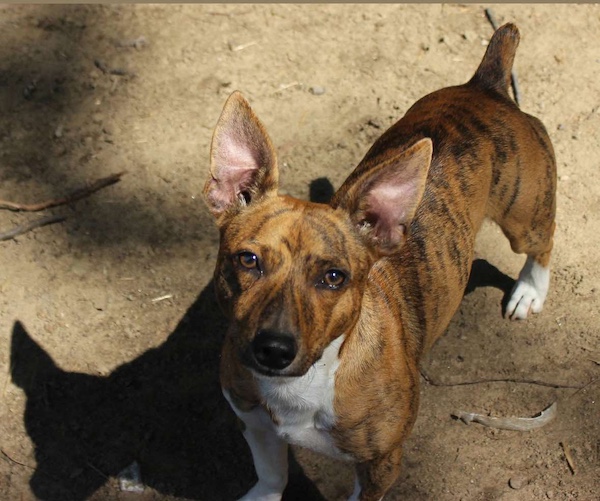
This history matters because brindle—a rare, recessive coat pattern—is accepted in the Teddy Roosevelt Terrier by both the AKC and UKC, but not in the Rat Terrier in either registry – and brindle coloring in the Teddy Roosevelt Terrier is the topic of this post.
So where did it come from?
In Rat Terriers, brindle is recessive to bi-color and dominant over tri color and sable, but it has always existed in the breed’s gene pool. It’s important to note that the foundation breeds behind the Rat Terrier are many, and some of the breeds seen on the family tree in the link include brindle as an accepted color, including the Feist, Whippet, and Bull Terrier.

Genetics is a funny thing. Traits can hide for generations and then suddenly show up again. Even though brindle is rare and recessive in Rat Terriers (the k<sup>br</sup> allele), it has always been in the gene pool. In “genetic-speak,” the K gene (K Locus) has a version called K<sup>B</sup> that acts like the boss of coat color—if a dog has it, their coat will usually be solid black or brown, no matter what the other color genes say. If a dog doesn’t have K<sup>B</sup>, then the other genes decide the pattern, like tan points or sable. Sometimes, if a dog has one K<sup>B</sup> and one k<sup>y</sup>, it can end up with brindle stripes instead of just a solid color.
The Teddy Roosevelt Terrier standard recognizes this historic genetic diversity and allows brindle, reflecting the breed’s foundation and the unpredictable way genetics can bring old traits back to the surface. Writers of the Teddy Roosevelt Terrier standard chose to allow brindle after the split from the Rat Terrier, likely as a nod to the TRT’s diverse ancestry and genetic reality. Rat Terrier fanciers took a different route.
Our sense (and it’s just an impression) is that Rat Terrier fanciers excluded the color because they preferred a clean aesthetic for the breed and prioritized crisp bi-color or tri-color patterns over brindle’s striped appearance.
If you see a brindle Teddy Roosevelt Terrier, it is a special sighting because while brindle is recognized and allowed by breed standards, is it an uncommon occurrence.
Images: Our thanks to Barnett W Lesa (Rambling Terriers) for giving us permission to share her photo of Abracadabra at the top, and in the middle, her brother, Pokey, both lovely brindle Teddy Roosevelt Terriers