An experiment you can try at home!
Take a rolled-up towel and wrap it firmly around your neck. Secure it well with duct tape or a belt. And yes, people will talk.
Now tuck your elbows into your sides and get a friend to wrap a long scarf, belt, or tube sock around them to keep you from extending them.
Next: Try going about your daily activities. You’ll quickly notice that simple tasks like walking, reaching, bending over, or even just leaning forward are far more difficult now that your movement is restricted.
The experiment simulates the biomechanical challenges a dog faces when its neck is too short for its breed.
Mechanically, the neck plays a vital role in the alignment of the spine, shoulder assembly, and overall musculature, serving as a pivot point for both head movement and weight distribution.While all dogs have the same number of vertebrae in their necks, the length and set of those vertebrae vary by breed and individual structure, affecting how effectively the dog can extend its head forward, balance during motion, and synchronize its front and rear movement for efficient gait.
This post focuses on dogs with necks that are too short for their breed standard.
As Carmen Battaglia often says, appropriate neck structure is essential for balance. A properly proportioned neck allows the head to act as a counterbalance during motion. In well-balanced dogs, the neck and head enable smooth power transfer between the front and rear assemblies. When a dog lacks this balance, it will naturally shorten its stride just to stay steady. Such a dog often takes more steps than one with proper structure to cover the same ground, and its limited reach is often apparent even from a distance. The front foot won’t land much farther than the end of its nose—because, structure-wise, dogs with short necks often also have straight shoulders. As demonstrated in your experiment, when your elbows were held close to your body, your reach with your arms was also limited.
Using a chicken or egg analogy, what comes first? Does a short neck mean straight shoulders, or do straight shoulders cause a short neck?
It is interconnected, of course, and structure experts like Edward M. Gilbert and Thelma Brown note that shoulder placement primarily determines both the actual and perceived length of the neck. Put another way, steep/straight shoulders tend to create the appearance of a short neck rather than a short neck causing straight shoulders. Dogs with long necks generally have well laid-back, sloping shoulders which allow for greater extension and smoother movement.
In contrast, dogs with steep shoulder angles often look like they have short necks because the space between the head and shoulders is visually reduced. This creates the impression of a shortened neck, caused by the sharp angle where the neck connects to the upright shoulder assembly—even though all dogs, regardless of breed, have the same number of cervical vertebrae.
How all this impacts a dog – any dog, not just a show dog – is that a short neck and straight shoulders limits a dog’s daily life. More concussion is absorbed by the dog’s bones rather than cushioned by muscle and tendon, this increases fatigue, and fatigue increases the risk of injury. Why? Because these marvelous creatures want to please us and will do what we ask of them even if structurally, they’re not up to running an agility course, catching a frisbee, swimming in a lake, or jogging with their person for very long.
Poorly bred dogs happen, and sadly, likely always will, but we can make a meaningful difference by supporting breeders who prioritize structural soundness in their respective breeds – it an act of kindness to both the dog and the owner.
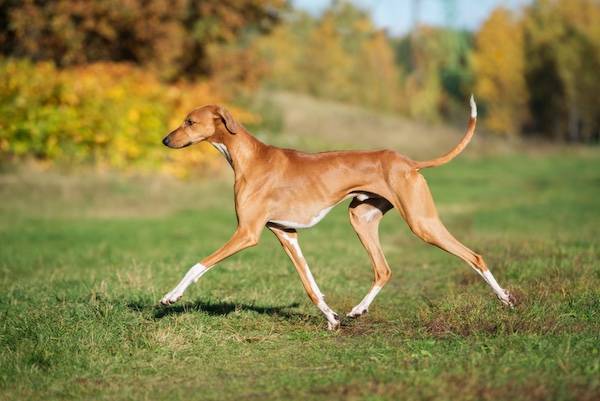
Image of gaiting Azawakh by ©Otsphoto/Dreamstime