
If you’ve ever gone to a dog show in your breed’s country of origin, or maybe you visited different breeders there, perhaps you noticed that the dogs might be stronger in some areas than they are in the United States, but weaker in others. Why is that?
The obvious (and most politic) answer is that breed standards between the AKC, FCI, Canadian Kennel Club, and the Australian Kennel Club (registries we chose at random) are different.
Why are they different?
Before we get to that, let’s look at the differences in a toy breed like the Italian Greyhound, and true confession: We asked an AI to compile the following chart because we don’t do spreadsheets (not well, anyway):
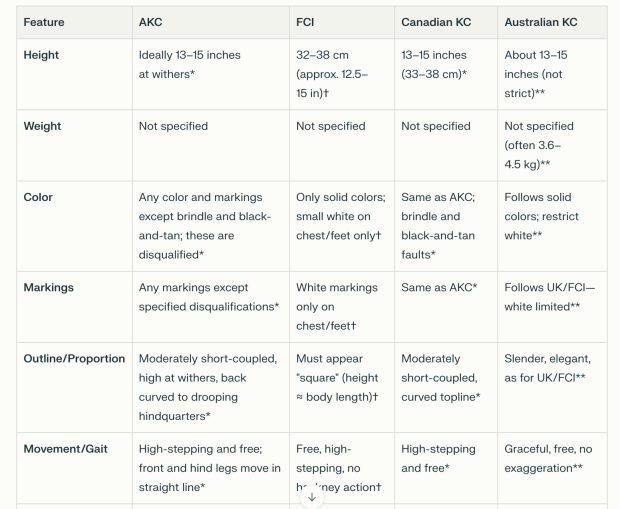
For those whose eyes glaze over at charts, the “short” of it is that Italian Greyhound breed standards across the AKC, FCI, Canadian KC, and Australian KC are largely similar, but they do differ in key areas. The AKC and Canadian KC allow more color variety and flexibility in size. In contrast, the FCI and Australian KC are stricter, requiring a height of 12.6 to 15 inches, and permit only solid colors with limited white on the chest and feet. The FCI also disqualifies dogs outside the size range and those with excessive white or incorrect gait. While all emphasize elegance and a high-stepping gait, the American and Canadian standards are more flexible, whereas the FCI and Australian standards place greater emphasis on precise proportions and traditional appearance.
After years of writing for various dog publications, a well known kennel club, and NPDD, we have learned that one of the most frequent questions we ask ourselves is simply: “why.” Why is “sedge” or “dead grass” an acceptable color in the Chesapeake Bay Retriever? Why are the hind feet of Dachshunds smaller than the front? And why are breed standards for some breeds different across the world?
We’re not Grand Poombahs of knowledge, but we share what we find. From what we can tell, regional priorities and breeding philosophies shape how each standard is written. The FCI, used widely in Europe including Italy, prioritizes measurable traits and strict conformation, while in North America, registries like the AKC and CKC tend to allow broader interpretation—especially in color, movement, and allowable faults—because of different population sizes and gene pool considerations. These choices reflect local functions, traditions, and even judging cultures. At the end of the day, variations in breed standards are probably shaped by a combination of “all of the above:” Tradition, genetics, and regional kennel club philosophies.
Does this mean a dog bred in one country can’t find success in the show ring of another? Not at all—and while we couldn’t find a widely documented case of an Italian Greyhound doing so, a Whippet named Miuccia offers a compelling analogy. Miuccia, a four-year-old Whippet from Venice, Italy, made history by winning Best in Show at Crufts 2025—the first time an Italian-bred dog claimed that prestigious title. She bested more than 18,000 dogs from around the world, no small feat. It’s worth noting that in Italy, the Whippet standard follows the FCI model, while Crufts adheres to The Kennel Club (UK) standard. Though the two are similar, they are not identical—yet Miuccia embodied the breed’s essence well enough to rise above differences. Miuccia’s success illustrates a broader truth across breeds: a dog that exemplifies the universal hallmarks of breed type—soundness, structure, and function—can transcend differences in registry standards and still win at the highest levels.

Breed standards, while different in detail, share the same fundamental structure and vision for a breed. No matter where, for example, a sighthound was bred, it must still have the structure to cover ground efficiently. We must also throw in the fact that at major shows like Crufts or Westminster, judges are presumably experienced in evaluating dogs from diverse backgrounds. And finally, there are the judges, themselves. Their background also impacts how they evaluate the dogs in front of them.
In the end, some would opine, if a dog adheres to the spirit of the standard—even if it comes from a registry with slightly differing criteria—it can still prevail.
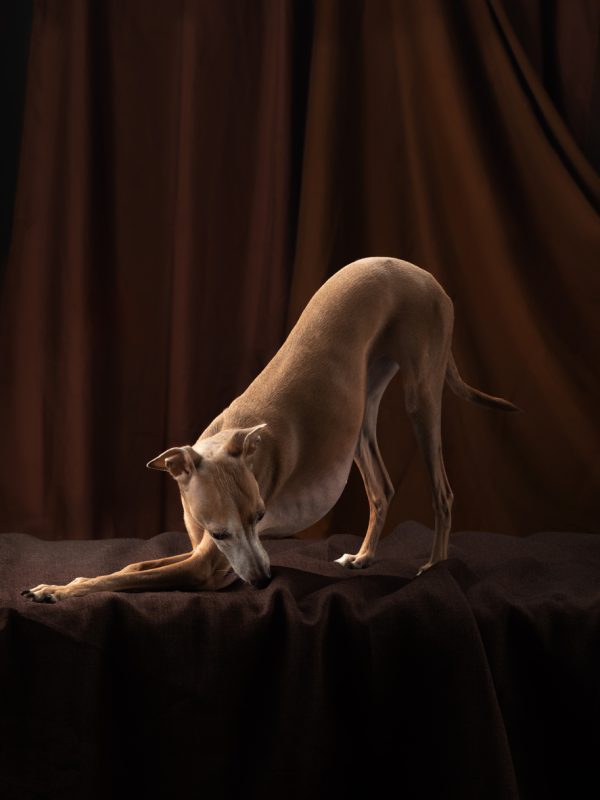
Photo of an Italian Greyhound by Anna-av iStock