It’s said that a dog with presence bears itself as if to say, “I’m the one.” It is a quiet confidence that needs no approval from others, especially in a show ring with other dogs. But when each dog in the ring is at least 32 inches and 120 pounds, it’s a challenge to give short shrift to any of them.
The Irish Wolfhound breed standard, however, is surprisingly concise (well under 1,000 words) when describing this tallest of the coursing hounds—let alone one whose first authentic written reference dates to 391 A.D., when the Roman consul Quintus Aurelius Symmachus thanked his brother for a gift of seven “Irish dogs” that “all Rome viewed in wonder.”
That sense of awe never disappeared, but the dogs themselves nearly did. Between a severe famine in the 1840s and the arrival of the shot gun supplanting the need for the hounds to control wolves, the Irish Wolfhound had largely vanished by the early 1800s, surviving more in art and literature than in living specimens. The modern standard, therefore, was not merely descriptive—it was reconstructive, an attempt to define and revive a lost national hound.
The first formal breed standard was written in 1885 in England, under the leadership of Captain George Augustus Graham, widely regarded as the architect of the modern Irish Wolfhound. That same year saw the formation of the Irish Wolfhound Club. Graham and his contemporaries created what was then called a “Standard of Points” or “Standard of Excellence,” establishing a blueprint for type, size, proportion, and character. Importantly, this document drew not only from surviving dogs but from historical accounts and visual references, including early 19th‑century artwork such as Reinagle’s depictions of the Irish wolfdog. This 1880s standard is the foundation document from which all modern Irish Wolfhound standards descend.
As the breed gained stability, efforts were made to refine how the standard was interpreted rather than to replace it. In 1904, writer and dog authority Herbert Compton introduced a 100‑point scale in The Twentieth Century Dog, assigning numerical values to traits such as head, coat, and movement. While influential, this system was ultimately set aside in favor of descriptive judging. A similar discussion resurfaced in 1928, when Rev. C.H. Hildebrand proposed reinstating point‑based evaluation at an Irish Wolfhound Club meeting—further evidence that the core standard remained intact even as fanciers debated its application.
In Ireland itself, formal stewardship developed slightly later. The Irish Kennel Club began offering classes for the breed in the late 19th century, and the Irish Wolfhound Club of Ireland, affiliated with the IKC, was established in 1925. Rather than creating a wholly separate standard, Ireland adopted and preserved Graham’s 1880s framework, reinforcing its authority from the breed’s country of origin.
The modern era brought formal international recognition. On March 13, 2001, the Irish Kennel Club, acting as the breed’s authority, issued the official standard recognized by the Fédération Cynologique Internationale (FCI Standard No. 160). While updated in structure and wording, this document remains unmistakably rooted in Graham’s original vision.
Today, whether under The Kennel Club, the FCI, or the American Kennel Club, the Irish Wolfhound standard reflects a remarkable continuity. More than a set of show‑ring guidelines, it stands as a historical artifact—one man’s disciplined effort to bring back a legendary hound and define it for generations to come.
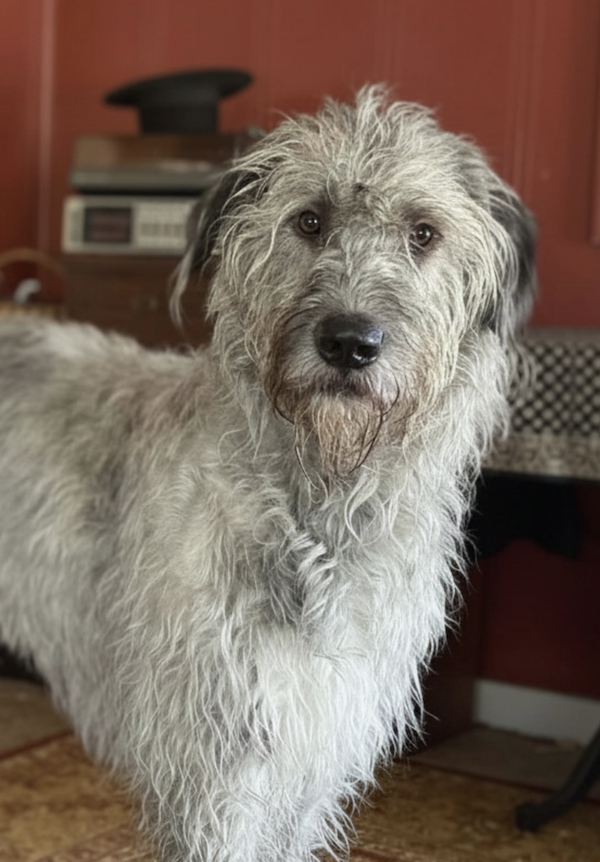
Photo of Falkor owned by Chantal McKinney