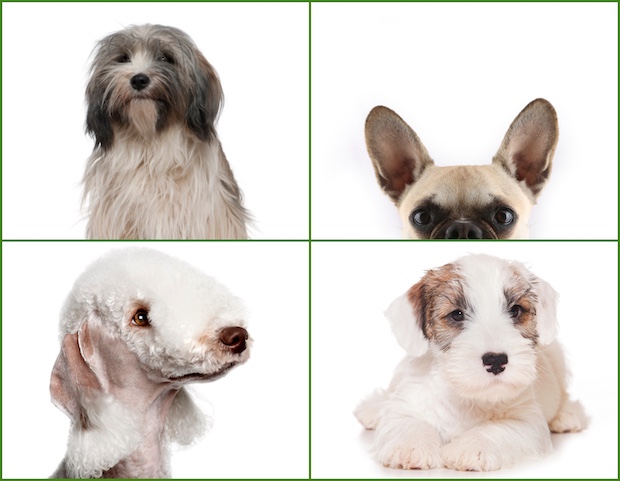
- From the French Bulldog standard: Hindquarters: Hind legs are strong and muscular, longer than the forelegs, so as to elevate the loins above the shoulders;
- From the Tibetan Terrier standard: Legs – Well furnished, with well bent stifles and the hind legs are slightly longer than the forelegs;
- Sealyham Terrier’s standard: Hind legs longer than forelegs and not so heavily boned;
- From the Bedlington Terrier’s standard: The hind legs are longer than the forelegs, which are straight and wider apart at the chest than at the feet
A few other breeds are often described informally as appearing to have longer hind/rear legs due to their angulation, topline, or build for speed/agility, but their standards do not explicitly require or state “hind legs longer than forelegs” as do the aforementioned breeds.
Envisioning a dog whose back legs are longer than their front might conjure up a lopsided sawhorse…..
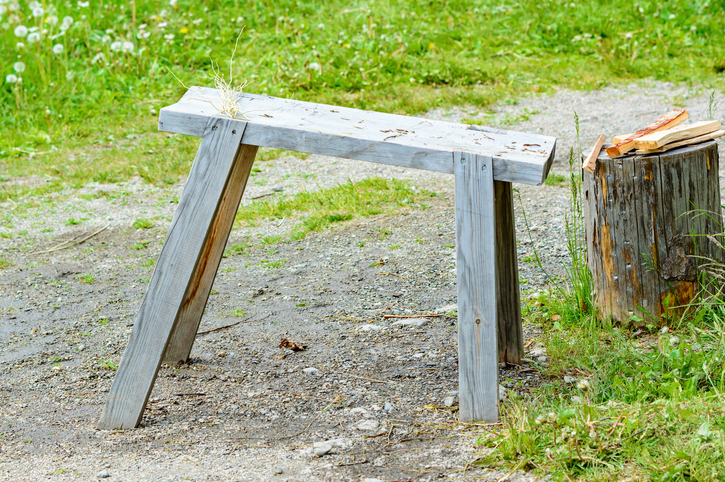
Credit:Reimphoto
But there is purpose behind this structure in all four breeds, and they do so in different ways, tied to terrain, speed, or body type.
Two of the breeds – the Sealyham and Bedlington – are renowned vermin hunters and use longer hind legs to turn their rears into driving engines for their work.
For the Sealyham Terrier, longer hind legs create an underground working machine. This low, strong, substantial dog can bring its rear feet well up under the body so that the hip, stifle, and hock flex like a compact linkage, allowing the rear feet to step in under the center of gravity and then extend to produce powerful, linear thrust along the axis of the spine. In a confined space, this configuration lets the hock act as a short lever against the ground so the dog can “jack” itself forward or backward, push its deep brisket and broad front into or out of tight soil, and then lock and brace the pelvic girdle and lumbar spine to resist being dragged or shaken by prey, while a level topline and short‑coupled body minimize flexion “give” so more of that rear‑generated force is transmitted directly through the back into the forehand and jaws.
In contrast to the Sealyham’s low‑gear torque, the Bedlington Terrier’s hind leg are a key part of the anatomical engine for the rotary (double‑suspension) gallop critical to the breed’s role as a “vermin assassin.” In this spring‑loaded configuration, flexion of the arched loin and trunk allows the hind feet to come well forward, ahead of the forefoot impact points in the gathered phase, and then trunk extension and powerful, well‑muscled hindquarters drive the dog into a true suspension phase in which all four feet leave the ground, greatly increasing stride length and ground covered per stride. The same longer‑appearing rear, narrow, clean front, and high‑clearance underline described in the standard create a chassis that can both gallop at high speed over open ground and quickly adjust line, allowing the Bedlington to overtake bolting targets, and to function as a silent, efficient hunter rather than merely a bolter.
The Tibetan Terrier (not a terrier at all) utilizes longer hind legs to function as a “four-wheel drive” mountain climber in the Himalayas. Its square, agile build is essential for navigating treacherous, vertical terrain. This structure is a distinct advantage in ascent-based propulsion; whereas a level-backed dog loses traction on steep slopes as its center of gravity shifts rearward, the TT’s elevated rear pushes its weight forward to keep its “snowshoe” feet firmly planted. Longer rear limbs act as a vertical leaper’s engine, providing the upward thrust and reach needed to scale rocky outcroppings. Additionally, this build contributes to the breed’s signature elasticity and tight turning radius. This allows the dog to shift weight instantaneously and spring in any direction—a vital capability for maneuvering livestock on narrow ledges or traversing deep snow.
And here we come to the French Bulldog, neither vermin hunter nor intrepid mountain climber. In what way do longer hind legs serve this breed?
In contrast to the specialized propulsion of the hunting and herding breeds, the Frenchie’s requirement for hind legs that “elevate the loins above the shoulders” is rooted in its Bulldog history as a compact powerhouse. This anatomy isn’t about sprinting, but about balancing a notoriously front‑heavy, “muscular…of heavy bone…compactly built” frame: by shifting the center of gravity and giving the rear enough leverage, it provides stability and the ability to move a broad chest and massive head without being easily toppled.
The AKC standard calls for hind legs that are “strong and muscular, longer than the forelegs, so as to elevate the loins above the shoulders,” producing the classic outline of a short, compact body with a slight fall behind the shoulders and a rise over the loin (the roach back), set on very short, stout forelegs and longer, muscular hind legs. Functionally, that longer, strong rear and well‑let‑down hock act as the power unit for this front‑loaded dog: by allowing the hind feet to step well under the body and push off, they generate the quick, powerful thrust needed for a steady, compact gait, while the elevated loin and arched back help transmit that drive through a short, strong spine into the forehand, echoing the compact strength and quick bursts of action prized in its Bulldog ancestry
In the end, we might succinctly explain with bullet points how longer hind legs serve four different breeds:
-
French Bulldog: Stability and forward-leaning leverage for anchoring.
-
Sealyham Terrier: “Jacking” power and subterranean extraction torque.
-
Bedlington Terrier: Spring-loaded extension for the double-suspension gallop.
-
Tibetan Terrier: Forward-weighted traction and vertical drive for climbing.
Collage photos: Sealyham Terrier by Anna Utekhina/Dreamstime; Bedlington Terrier and Tibetan Terrier/Depositphotos; French Bulldog by Shane Degeus/Shutterstock;