Our readers tell us they enjoy the biographies we share on these pages, anecdotes about celebrities, scientists and inventors, literary giants – and the dogs they own. When we accompany these posts with artwork, it’s always to put a face to a famous name. Until now, however, we don’t think we’ve ever shared a piece of art and made the subject in the image the focus of a post when that person is (not to be unkind) a nobody. Serious students of art history, however, learn that the person on a canvas can often be more interesting than the artist.
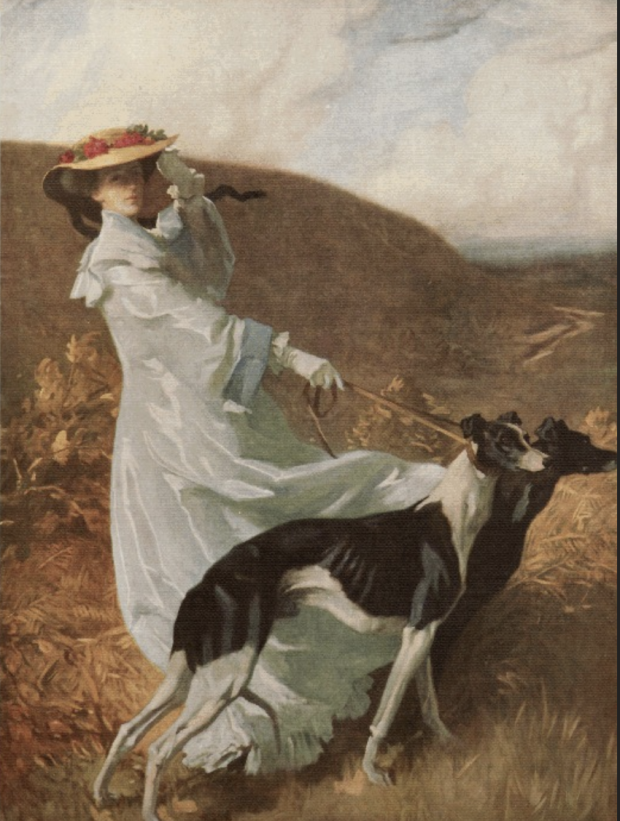
Between 1903 and 1904, Charles Wellington Furse painted this image of a young woman standing on a windswept moor. She’s gripping the leashes of two straining Greyhounds with one hand, while clutching her hat against the breeze with the other. We refrain from examining the painting as an art critic would by delving into why Furse’s composition is so successful, but we will go so far as to note that between the name of the painting,”Diana of the Uplands,” and how the model is portrayed, art historians largely believe the painting is an homage to Diana, Roman goddess of the hunt.
We disagree. We believe the homage is really to the model.
Her name was Katharine Furse (she spelled her name with two ‘a’s”), and she was married to the artist. She was a young wife and mother when Charles portrayed her as a kinetic, empowered woman grappling the elements and two large dogs. This was at a time when women were presented in a refined, elegant, and often passive manner reflecting Edwardian ideals of femininity.
This wasn’t Katharine.
She just wasn’t a follower.
The daughter of writer, John Addington Symonds, Katharine would later become Dame Katharine Furse for her accomplishments. She became Commandant-in-Chief of all British Red Cross Voluntary Aid Detachment (VAD) nurses during WWI, and then became the first Director of the Women’s Royal Naval Service (essentially, the head of all women in the Royal Navy).
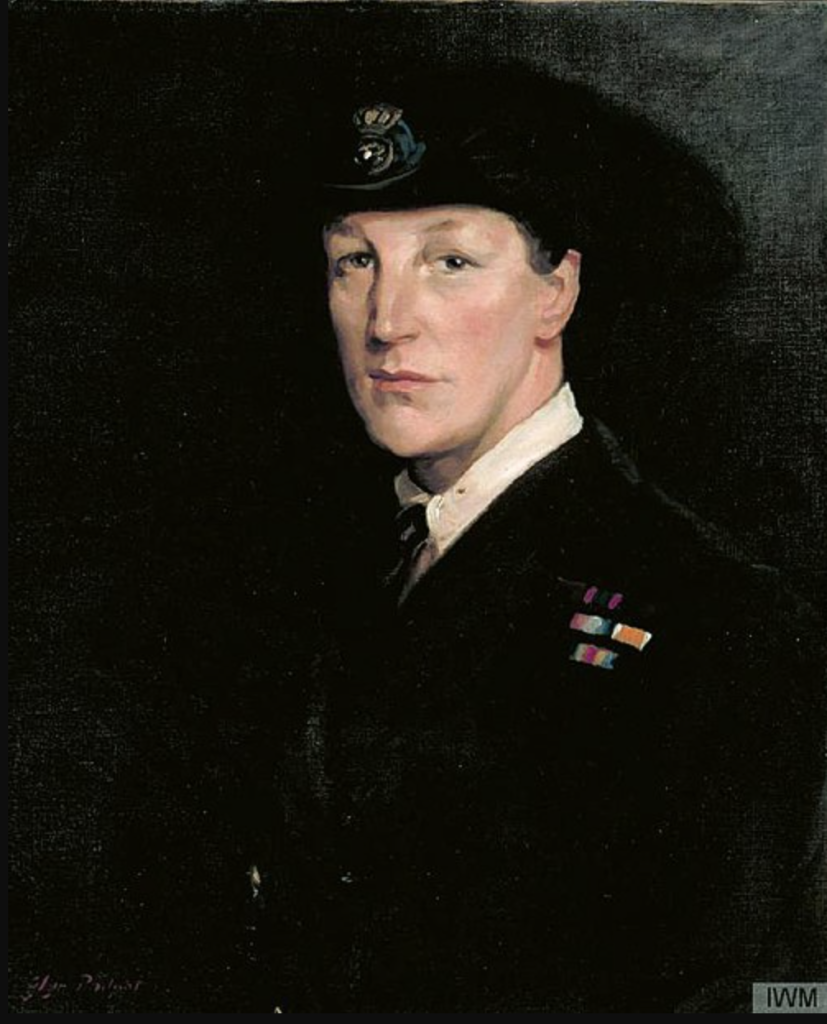
Painting of Dame Katharine Furse from 1920 signed by Glyn Philpot is in the public domain
She helped invent how large groups of women served in modern war. Katharine wasn’t just a leader, she helped shape the system. She revolutionized women’s war service by transforming the VADs from a loose group of volunteers into a disciplined, well-trained national nursing corps with standardized roles, training, and welfare—a template for future women’s services. As the first Director of the WRNS, she helped define what jobs women could do in the Navy, set recruitment and training standards, and insisted that women were treated as serious naval personnel rather than accessories or decorative helpers. She shaped the structure of women’s auxiliary branches that followed. Most importantly, she was a visionary advocate for the professionalization and respect of women’s war work, pushing for proper organization, pay, and recognition at a time when such views were groundbreaking. Another painting of Katharine, this one by Glyn Philpot, would capture this “later” Katharine who modeled in uniform.
We circle back, as we always must on these pages, to the dogs. It’s frustrating that more can’t be found about the Greyhounds, and as far as we can tell, one of two things is true: That the artist, Charles Wellington Furse chose Greyhounds to evoke the Roman goddess Diana often depicted as a huntress accompanied by such dogs. Or, as some hint (but without evidence), the Furse family’s rural lifestyle makes Greyhound ownership plausible.
Either is interesting because one hints at the choice of breed for a dynamic, active woman, while the other is symbolic of freedom, speed, and the untamed spirit of the uplands that Katharine inhabits in the painting, merging her modern identity with classical myth.
The painting of “Diana of the Uplands” by Charles Wellington Furse (1868-1904) is in the public domain