Socks, jackets, breeches, shawls, collars, trousers, skirts, culottes, and cape – everyone knows these to be articles of clothing. Fanciers will also recognize them as terms used in different breed standards from various registries to describe coat markings, patterns, or furnishings on dogs.
There is a word missing from our list, however, and you might have to be a Chinook fancier to spot it because to our knowledge, the Chinook’s AKC breed standard is the only one to use it. The word shows up in the section on color. It reads: “Any other white markings are undesirable, including blazes, socks, and scarves.”
While symmetrical white or cream to pale gold markings are acceptable on the cheeks, throat, chest, breeches, and underside of the Chinook, any other white markings are—undesirable. To be clear, “scarves” in this context refers to white areas around the neck and chest, resembling a shawl or collar draped over the shoulders. In fact, the AKC Chinook judging exam even includes a question about undesirable white markings, with one of the possible answers being “scarves.” These standards, however, reflect breed consistency and heritage, not the health or temperament of individual dogs, all of whom can be beloved companions regardless of markings.
As a rule, asking “why” something is included in a breed standard is usually best answered by considering the breed’s function or purpose. In the case of a white “scarf” marking, however, it does not affect a Chinook’s temperament, health, or working ability. The restriction appears to be intended to preserve the historic phenotype—a uniform tawny dog with distinctive darker shading that consistently bred true to look “uniquely Chinook,” rather than resembling any other sled breed. In this context, the parent club reflects both the breed’s historic heritage and the breeding goals of founder Arthur Walden, who emphasized maintaining pedigree recognition.
The breed carries genes for dominant tawny coloring with recessive modifiers that can occasionally produce white patches. White spotting in dogs is often influenced by the S locus (the piebald locus) and related modifiers, which determine how pigment cells migrate during development. In Chinooks, larger white areas like scarves likely reflect the presence of recessive alleles that are normally suppressed in typical breed coloring. Again, they do not impact the dog’s health or working ability, they simply represent variation in how the genes for pigmentation are expressed. That said, deviation from the original Chinook ‘look’ drifts away from pedigree standards important to a rare breed’s conservation. And yes, the Chinook is rare. In 1965, the Guinness Book of World Records recorded the Chinook (for the first of three times) as the rarest breed in the world with only 125 dogs alive. When Chinooks were fully recognized by AKC in 2013, numbers had improved, but there were still only 813 Chinooks registered. As of 2024, the AKC’s list of breed popularity rankings put the gentle and affectionate Chinook at #182 out of 201 breeds.
It is uncommon for breed-standard phrasing to emphasize appearance rather than function, but maintaining uniform coloration helps preserve the historic phenotype, reinforces breed identity, and supports the careful conservation of the rare and distinctive Chinook.
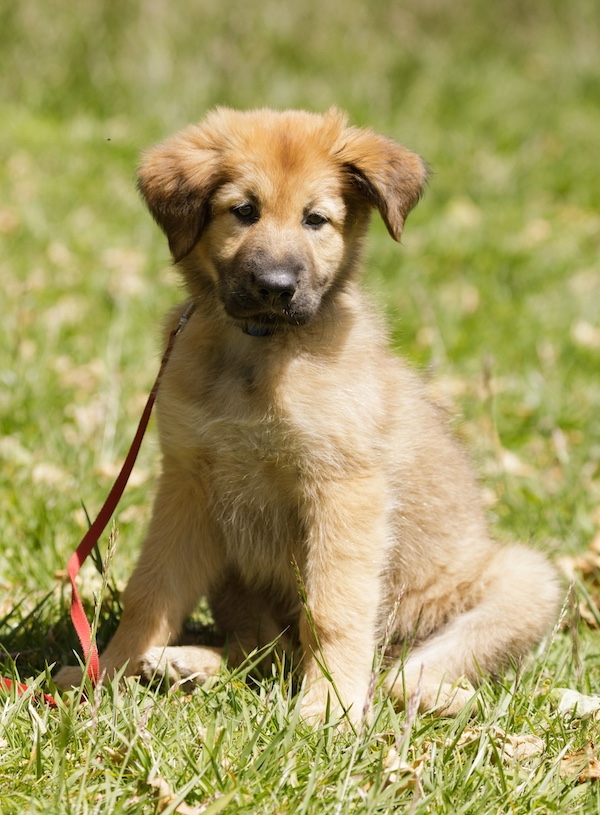
Image of a 9 week old Chinook puppy by ©Yuval Helfman/Dreamstime