Daisy’s lesson: At a February dog show hotel, Daisy exercised her dog on a patch of grass by a fence on which were bare, hairy vines. She thought, “Poison ivy? Dead in winter—no leaves, no worry.” She dismissed one accidental brush against her calf……until ring time. By then, her leg was covered in painful, weeping blisters that kept spreading. The urgent care doctor shook his head: “Urushiol stays toxic year-round. Winter vines still bite.
Roy’s lesson: You can imagine Roy’s surprise when, after having grown up with the old adage that lightning never strikes the same place twice, found out the hard way that it absolutely can. Roy Sullivan was a career National Park Service ranger in Virginia. Over the span of 35 years, he was struck by lightning seven separate times. Not during one freak storm, mind you, but in completely different incidents between 1942 and 1977.
Like Daisy and Roy, we also had a long held assumption that turned out not to be true—though happily, being wrong didn’t cost us.
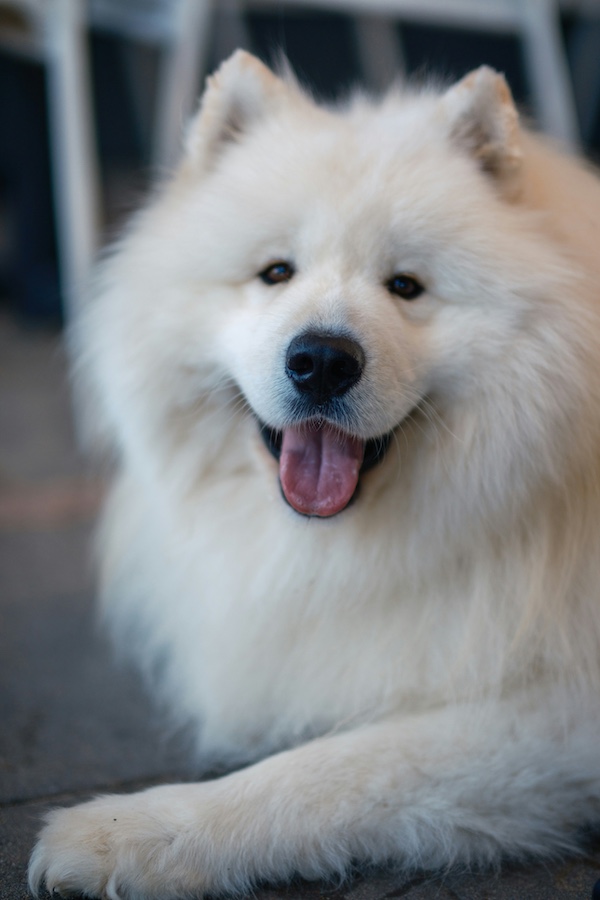
For reasons we don’t know, we had always thought that the word, “commissures” appears in the Samoyed’s AKC breed standard. The breed is, after all, famous for its smile, and “commissures” is another word for where the upper and lower lips join together. We even wrote about it eight years ago in this post:
We were wrong. Or to be more accurate, we weren’t wrong that those parts of a dog’s mouth are called “commisures.” We were wrong in thinking the word was in the standard. We’ll circle back to that further down.
In every dog, the corners of the mouth—the labial commissures—are tiny hinges with outsized importance. These are the points where the upper and lower lips meet, formed by skin, muscle, and mucosa working together. They control not just how the mouth opens and closes, but how the dog expresses itself. Think of them as the “secret sauce” behind a “smile,” a snarl, or a silent, alert gaze.
Breed standards pay close attention to these corners because they shape type and function. In tight-lipped, elegant breeds, the commissures are neat and tucked away, creating a clean, dry outline. In Molossers or guardian dogs, the corners are heavy, loose, and folded—producing the pendulous, drooping lips that signal power and protection. Whether the standard uses the word “commissure” or speaks simply of “corners of the mouth,” it’s all about the way those hinges are built and how they finish the muzzle.
So why doesn’t the Samoyed standard use the word at all, given how famous the “Sammy smile” is? We suspect that it’s largely a matter of drafting culture. The Samoyed’s English‑language standards have always described the smile in plain terms—black lips “slightly curved up at the corners of the mouth”—rather than with technical anatomy. The concept is there (it’s about how those hinges are set), but the words are deliberately understandable.
By contrast, the only AKC breed standard that actually uses the word commissures is the Belgian Malinois, and it does so in a very specific way: “The mouth is well split, which means that when the mouth is open the commissures of the lips are pulled right back, the jaws being well apart.”
Why does this standard include the word when (as of this post) no other standard does?
We suspect it’s because it was heavily shaped by a Continental, FCI‑style drafting tradition that is comfortable with anatomical terminology, and because that phrase captures a very particular, functional picture in very few words. “Mouth well split” on its own is idiomatic; tying it to “commissures of the lips pulled right back, the jaws being well apart” explains exactly what judges should see when the dog opens its mouth: long, clean, far‑retracting hinges, not a short, clamped, or heavy mouth. In the Malinois, that open‑mouth geometry is part of the overall dry, sinewy, ready‑for‑work type, so the drafters kept the precise anatomical term instead of smoothing it into lay language.
Instead of disappearing into technical glossaries, those mouth corners are working front and center every time a dog steps into the ring or curls up on the couch. They frame the outline of a head, decide whether a mouth reads as clean and dry or heavy and dripping, and quietly carry some of the most important clues to how a dog feels about the world. We don’t have to use the word commissures to be shaped by them—but once we know what they are, it’s hard not to see them (or that word) every time we look at our dogs looking back at us.
Photo by Haberdoedas/Unsplash