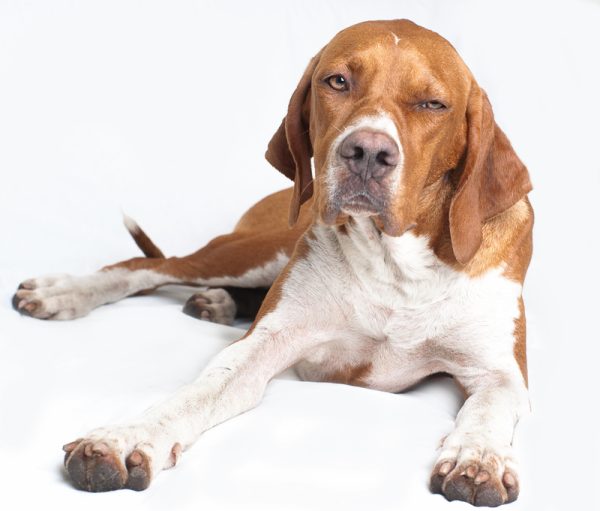
There are a lot of ways to get a Pointer’s tail wrong if it isn’t correct to begin with: it can be too thick, not tapered (or both); it can be set too high or too low; it can be either too long, too curved, or it might be carried poorly. It might be sickled, the croup too steep, or it was docked at the wrong length. Sometimes it hangs beyond the hock joint, or it’s perched more than 20 degrees above the line of the back. Rather than single out a dog for any of these sins, we opted for a bit of mischief: the Pointer in the photo is practically winking at us. We like to pretend he or she is fully aware that we chose this image because his (or her) tail is mostly hidden from view for reasons that will become apparent. Discretion—and a little inferred canine complicity—is often the safest strategy.
When it comes to the Pointer (or English Pointer, as the breed is listed with the FCI and the United Kennel Club) the tail isn’t just a detail—it’s a structural signature that’s also good for instigating a rousing debate among Pointer owners on both sides of the ocean. In his classic book, The Pointer and His Predecessors, William Arkwright emphasizes the importance of the tail as a marker of true Pointer type, purity, and breeding.
The Pointer’s tail is unmistakable for being so, well, ‘Pointy.’ It starts thick at the root and tapers cleanly to a fine point, resembling a “bee sting” (a term we found only in the UKC standard). No other breed has this exact combination: the tail can not be rope-shaped, sausage-fat, or fail to taper. It should never curl over the back or show any kink; those are hints of hound ancestry rather than true Pointer type (and why William Arkwright considered the tail as evidence of breed purity). The ideal length is no longer than the hock, usually ending a bit short of it. Carriage is everything: the tail is set straight off the spine, with a slight rise from the croup, and should never be carried more than 20 degrees above the back.
How the tail is carried, and how it moves, is where discussions can get spirited on either side of the Pond.
In a European show ring, there seems to be a clear preference for a tail that rides level with the back or even a bit lower. Some call this a “dead tail.” There’s no animation, the tail is there for balance. Energy spent wagging or whipping the tail fore and aft is wasted energy since it isn’t helping the dog run or hunt. In a European field trial, a Pointer with a high, lively tail might easily get marked down since a tail that hangs quietly and only moves when absolutely needed is preferred. In short, Europeans prefer a tail that minds it’s own business.
In America, a Pointer’s tail is not penalized for ‘attitude and visibility.’ A high, upright “12 o’clock” tail (especially when on point) is favored; in the field, judges and handlers want to see a tail that’s alive with energy, lashing from side to side. It is bold, and makes the dog stand out in thick cover. The look has become so ingrained in American field trial culture that without a high, animated tail (sometimes called a “cracking” or “merry” tail), a Pointer stands to be overlooked.
The irony is that while a Pointer’s tail’s position has little to do with actual scenting or hunting ability, the movement of the tail is important enough to be considered by some breeders in their breeding decisions. The robust debate is hardly new. Hunters have quibbled about active or quiet tails, and how they are carried, since the 1800s.
There is no getting around how unique the Pointer tail is, but could some of our readers have guessed it to be so culturally charged?