To understand the point of this post, we ask you to first to scroll down and watch the video clip below:
This clip of a girl walking through tall grass illustrates what we tend to do with our legs and feet when we have to navigate vegetation that grows taller than our knees. In humans, walking through high or uneven grass generally requires increased hip and knee flexion during the swing phase to ensure that our foot clears the vegetation to avoid tripping. This results in a higher leg lift compared to walking on smooth, flat ground.
As we’ve mentioned on these pages before, the question we ask ourselves the most often as we learn about dog breeds is “why.” Breed standards tell us the “what” of a breed, but not always the why.
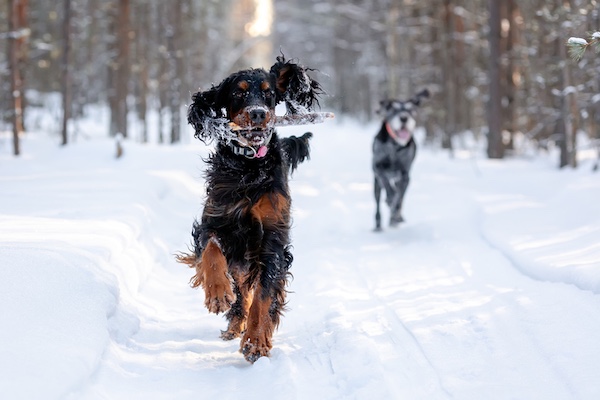
The Gordon Setter has a unique front movement as mentioned in its Illustrated Guide, and also in the breed standard which reads: “When viewed from the front, the forefeet move up and down in straight lines so that the shoulder, elbow and pastern joints are approximately in line…When viewed from the side, the forefeet are seen to lift up and reach forward to compensate for the driving hindquarters.”
We thought it would be helpful to show how we walk in tall grass before explaining that a Gordon Setter walks in the same terrain much the same way for the same reason. Now we’re going to show you that front movement in the video clip below. The Gordon Setter is Sh Ch Lourdace Fulcrum JW who went on to win the Gundog Group at Crufts in 2016:
The other three Setters are typically hunted in open fields, but because the Gordon Setter is the heaviest of the four with more bone and body, it is eminently suited to work in taller, heavier brush.
Its forefeet move up and down in straight lines, keeping the shoulders, elbows, and pastern joints approximately in line. This allows the front legs to lift and then fold back at the pasterns, preventing the feet from getting caught in thickets. A sound Gordon Setter can work all day because the breed’s front structure supports this unique movement. The shoulders lay well back with the shoulder blade and upper arm forming roughly a 90-degree angle, and the front legs are straight and well-boned with short, strong pasterns that have a slight spring. The pasterns and angulation create a shock-absorbing effect that helps the dog handle hard work over rough ground.
If we dare to suggest the importance of reading a breed standard, we’ll be bold enough to encourage you to ask yourself “why” as you read it – and then investigate what the dog does for a “living,” and where.
Image by Evgenia Glinskaia/iStockPhoto