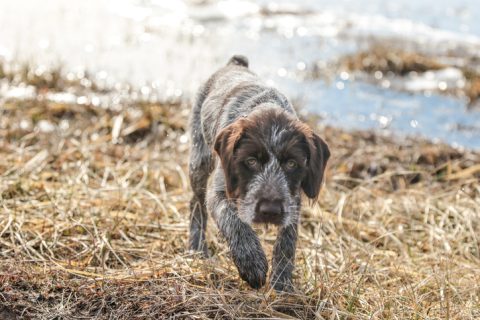
Hammerhead: The term can refer to a range of cycling products, a manufacturer of construction equipment, a marine descaler, and of course, one of the most specialized and visually striking sharks in the ocean. But the term also applies to the head carriage of a versatile gundog when the dog is at work, and that breed is the fabulous Wirehaired Pointing Griffon. Let’s spot the dog in action:
When a
While quartering and searching for birds, a Griff typically carries his or her head level with or slightly ahead of their back. The head is held slightly forward, the nose slightly tilted downward, an alignment that is referred to as the “hammer” head carriage. Why? See if the illustration below helps (and look hard to see the outline of the hammer):
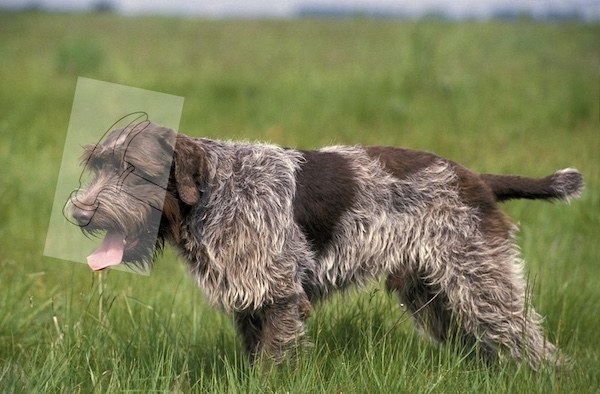
As we often stress on these pages, asking “why” about an aspect of a dog goes a long way to understanding why standards are written the way they are, and in this case, it is the American Wirehaired Pointing Griffon Association’s “working standard” to which we refer.
When the head and nose are in line with the back, and the neck is extended over bent or crouched legs during pointing, it is easier for the dog to move catlike in a crouched position, a posture necessary for accurate tracking and pointing in the field. Perhaps more importantly, the head carriage maximizes the dog’s visual acuity while allowing him to scent more efficiently at a distance, all while maintaining the dog’s stability and balance as he keeps still. Since the “hammer head” essentially acts like a pointing tool by directing attention, it also serves to signal to the hunter where exactly the game is, all without the dog having to move.
It’s really quite extraordinary.
Top photo by PharmShot/iStock. Photo (without hammer overlay) is by © Slowmotiongli | Dreamstime