Consider a playground see-saw.
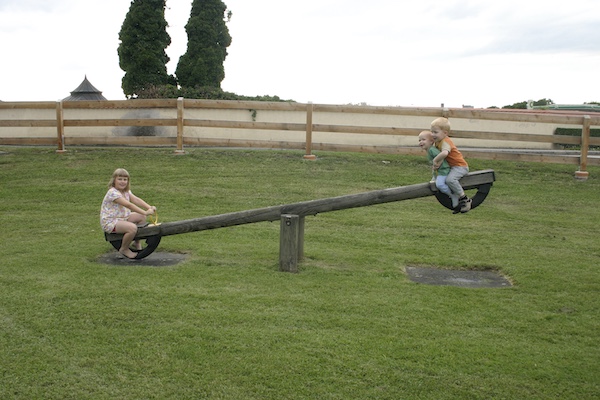
A seesaw is always more fun when people of equal weight are on each end. The board moves smoothly and predictably instead of thudding to the ground on one side or launching a lighter-weight child into the stratosphere.
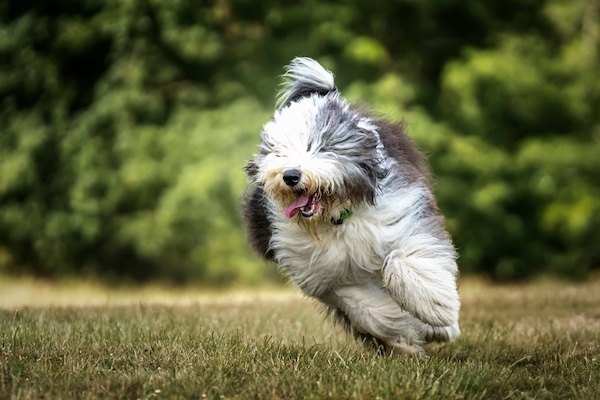
In much the same way, a structurally correct dog is “evenly weighted,” with the front and rear assemblies in balance, bone length and angulation matched, and the topline and underline working together so no single part is overloaded. And this brings us to the Old English Sheepdog.
Squareness in the Old English Sheepdog is fundamentally about force distribution and mechanical efficiency, which directly benefits both herding work and agility performance. The OES is neither long and low nor tall and short-backed. His or her height is divided nearly evenly, with approximately 50% from the top of the withers to the elbow and 50% from the elbow to the ground. This results in a center of mass that sits well inside the base of support rather than hanging toward the front or rear. This geometry allows both the forequarter and hindquarter to contribute more equally to propulsion and braking, so each stride costs the dog less energy, produces less localized stress on joints and soft tissues, and results in a herding dog capable of sustaining ground-covering, efficient trotting for long periods while circling stock, flanking, and adjusting position without one end of the body tiring first. It is also what enables the breed to make tight turns, quick accelerations, and rapid changes of direction. A balanced front-to-rear relationship reduces deceleration time and allows faster redirection of momentum because the dog is neither “nose-heavy” nor “rear-heavy” when planting and pushing off.
How does this manifest when the dog is working sheep?
It reveals itself in how cleanly and economically the dog manages both straight-line movement and the lateral and rotational demands of real stock work—sudden flanks, pivots to block an escape line, and constant side-to-side adjustments around a flock. A square, well-balanced body with correctly placed limbs creates a wider effective support polygon and a more stable response to multidirectional loads. As a result, when the OES has to slide up the side of the group, plant and turn a breaking ewe, or shuttle laterally at the head, it can decelerate, pivot, and re-accelerate without slipping, scrambling, or over-torquing joints. In practice, you see a dog that drops smoothly into a shorter stride, rotates around the flock with minimal loss of rhythm, and comes out of the turn immediately back in balance rather than having the front dig in or the rear swing wide. Over the course of a day’s droving, that stability under lateral and rotational forces reduces micro-trauma and localized fatigue, allowing topline, footfall, and carriage to remain consistent instead of breaking down as one end of the dog tires or begins compensating. Because no single region of a balanced dog is forced to absorb a disproportionate share of impact or propulsion, a square, balanced OES is less prone to chronic overload patterns such as shoulder strain or lumbosacral stress.
It is this balance translates into higher working endurance on stock and greater resilience in repeated high-output efforts—whether droving over rough terrain or negotiating an agility ring.
If there is an addendum to this, it is that working breed standards are written with soundness and efficiency in mind.
Image by chrisukphoto/Shutterstock