Whether one has traveled throughout the southern half of the United States or simply interacted with people from different parts of the South, two facts quickly become apparent: most Southerners speak with a recognizable “Southern” accent, and there is no single way to speak it. Linguists can distinguish numerous subtypes of Southern accents—including Tidewater, Piedmont, Appalachian, Louisiana Gulf, Ozark, Texan, and Lowcountry, among others. For example, a Virginian drawl is markedly different from a Texas twang. This variation stems from the complex blend of English, Scots-Irish, and African linguistic influences brought by early settlers and immigrants to different Southern regions. These speech patterns merged during colonial times and further evolved in geographic and cultural isolation from the North. According to linguistic research published by Cambridge University Press, this unique mix of settlers, paired with prolonged regional isolation, ultimately produced the diverse and distinct phonological traits recognized as Southern American English today.
And here we pivot—awkwardly—to a related question: Is there a single breed that the general public regards as the most stereotypical representative of the American South?
Ask this question of cynologists, and you’ll likely receive an answer very different from what John and Jane Q. Public might give. Most experts point to the Carolina Dog—also known as the American Dingo, Dixie Dingo, or “yaller dog”—as the archetypal Southern breed. Its roots trace back to ancient feral populations in the Southeastern U.S., with concentrations around the Georgia–South Carolina border. In the 1970s, ecologist Dr. I. Lehr Brisbin Jr. brought attention to these dogs, which had survived wild and largely unaltered in swampy woodlands. Despite this compelling history, the Carolina Dog is still unfamiliar to most of the general public.
Sadly, the same may be true of another Southern gem: the Boykin Spaniel. Developed specifically in South Carolina, the Boykin was bred to meet the unique demands of sportsmen navigating the state’s swampy rivers and marshes, becoming a natural upland and waterfowl hunter prized for both ruggedness and manageable size. Some hunters joke that the breed’s biggest fault is being “too damn cute.” Despite being named South Carolina’s official state dog in 1985, public awareness outside the South remained limited for decades. The Boykin’s story—tracing back to an early-1900s stray named Dumpy, who demonstrated remarkable hunting aptitude and became breed foundation stock—is well-known to local hunters, but less so nationally. Only after Stephen Colbert, host of “The Late Show,” introduced his own Boykin, “Benny,” to a national TV and social media audience did many Americans first hear of the breed.
The number of breeds originating in the south is almost an embarrassment of riches: The Blue Lacy, Plott Hound, Catahoula Leopard Dog, American Foxhound, Treeing Feist
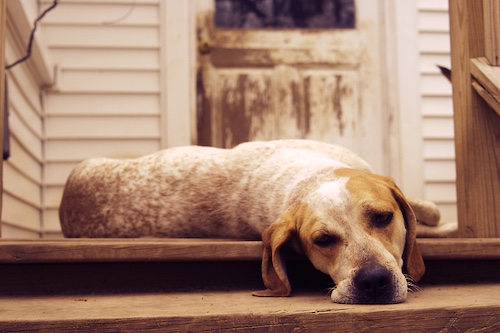
Lazy dog by © Robindoddphoto/Dreamtime
(UKC) and American Leopard Hound to name a few that are officially recognized. But when we circle back to what the public associates with the south, we have to think it is the echoing bay and long, velvety ears of a coonhound.
But which one? As of this writing the AKC fully recognizes six coonhound breeds: the American English Coonhound, Black and Tan Coonhound, Bluetick Coonhound, Plott Hound, Redbone Coonhound, and the Treeing Walker Coonhound. Different coonhounds developed because hunters across regions bred their dogs for specific game, terrain, and hunting style — some emphasizing cold-nosing and slow, methodical trailing, others speed and treeing ability — which led to distinct types optimized for local conditions and preferences.
To the average person, however, their vision of a coonhound is a hound sprawled out on a front porch, its velvet ears draping the steps and its deep, echoing bay marking time in the humid Southern air. We’d argue that the dog they envision may be a Redbone Coonhound because of a book later adapted into a movie: Where the Red Fern Grows.
We don’t forget movies that make us sob.
When it comes to identifying the quintessential southern breed, there is room for discussion, but this is our take. For now.
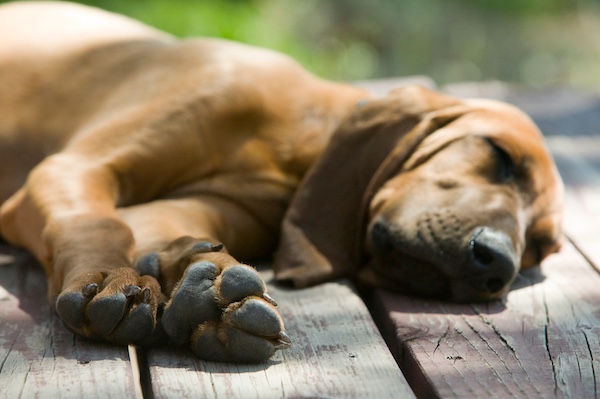
Top image by AZP Worldwide/Adobe
If you like what we write, help us pay our bills: National Purebred Dog Day’s tip jar