We may never know with certainty why the color, “red pepper” was excluded from the second Standard Schnauzer breed standard.
We know from the Standard Schnauzer Club of America’s Illustrated Guide that the first German breed standard, published in 1884, accepted a wide range of colors, including “red pepper.” When the second breed standard was written in 1907, colors were limited to salt and pepper and black. As non-Standard Schnauzer owners, it’s easy (and a bit flip) for us to say, “What a pity.” In our modern mind’s eye, we envision a Schnauzer with a wiry coat that has a warm, spicy vibe—like a dash of paprika or chili powder before it goes into a pot of Cincinnati Chili. “Red pepper” might have been like the rusty auburn seen in the thumbprints or penciling of other breeds that retained reddish colors in their standards. But we are fans of purebred dogs, and the thinking behind the color omission was logical and understandable.
By 1907, German breeders were getting serious about defining what made each breed unique, and the Wire-haired Pinscher (as the Standard Schnauzer was known then) was no exception. Essentially a cousin of the Smooth-haired Pinscher (today’s German Pinscher), the Standard and the Pinscher were often interbred. Given the wide latitude afforded colors in the the 1884 standard, 19th century Standard Schnauzers could be seen in a range of shades including rust-yellow, gray-yellow, black, iron-gray, silver-gray, flax-blond, or dim gray-white.
When the Pinscher-Schnauzer Klub was formed in 1895, breeders wanted to split the Wire-haired and Smooth-haired Pinschers into separate breeds. By 1907, the Schnauzer had its own identity, and it was Josef Berta, who, as the club’s influential first chairman, drove the standardization process and shaped the Schnauzer’s distinct look by limiting its colors to salt and pepper and black. A narrow color field gave consistency, and though our vivid imagination envisions it like a fever dream, we struggle to picture the striking Standard Schnauzer in any colors beyond those the standard allows.
As an aside, removing “red pepper” from the Standard Schnauzer’s gene pool was probably straightforward because it was likely a recessive trait, easily outcompeted by the dominant salt-and-pepper and black coats. The Klub’s studbook, established in 1895, helped breeders track pedigrees, and by picking dogs with dominant genes for salt and pepper or black, breeders could remove the “red pepper” in just a few generations.
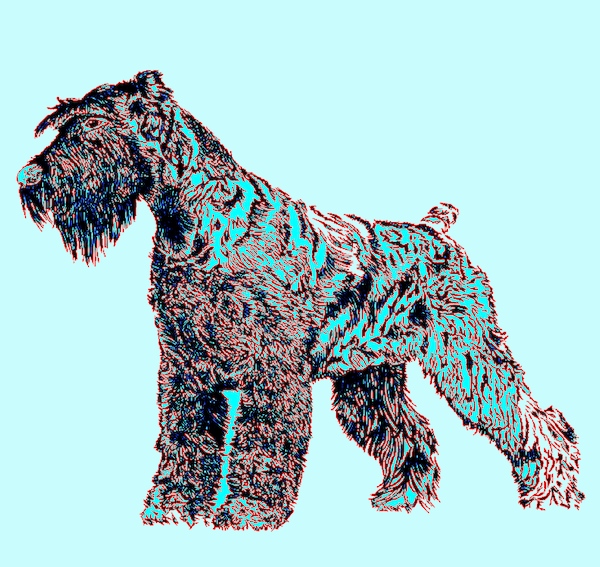
Image: Sketch of Standard Schnauzer by © Strokata/Dreamstime