Trypophobia.
If you suffer from it, this might be the post to avoid.
Trypophobia is an aversion or disgust toward patterns of small holes. We first encountered it when someone we’d known for years acted “off” after being handed a coarse-pored sponge during a kitchen clean-up. Though he laughed it off, he admitted that patterns of holes — honeycombs, loofahs, bubble wrap, even Swiss cheese — had always made his skin crawl. Everyone has something, we figured, and moved on to the next dirty dish. But if our friend is reading this — dude, move on.
We were reminded of the phobia when recently reading that scientists may finally have an explanation for the mystery holes in the Peruvian Andes– more than 5,000 evenly spaced pits carved into rock along a ridge that have puzzled scientists for over 52 centuries. Theories have ranged from water collection and burial sites to planting pits or some sort of military defense. But the most recent research, using sediment analysis and drone mapping, now supports the idea that the holes were used to measure, organize, and record tributes and taxes for the Inca and earlier Chincha rulers — essentially an ancient marketplace or “spreadsheet.”

Now, if they could just figure out the “snout pits” created by Carolina Dogs, we might have another mystery solved.
If you’re new to the breed, let alone the term, “snout pits,” a quick primer: The Carolina Dog (also called “America’s natural dog”) is also among the most unique for its behaviors, one of which is an activity that can leave a backyard looking like it has been overrun by gophers. Take a look at this video clip (and be sure to turn up the sound):
Dr. I. Lehr Brisbin, Jr., a biologist and research ecologist at the Savannah River Ecology Laboratory (University of Georgia), was the first person we know of to have formally observed and documented the behavior. It was he who coined the name, “snout pits” for the holes he observed Carolina Dogs making. He noticed that the holes exactly fit the muzzle of the dog, that more females than males made them, that they were made most often in late autumn and winter, and observed the dogs licking or eating something from the bottom of the hole.
We first wrote about the snout pits back in 2018, and after reading about the Peruvian holes, we wondered if any more had been learned about snout pits in the last seven years. Shockingly, it appears not. Snout-pit behavior of the breed seems to remain under-researched as we found no peer-reviewed articles, no targeted study; most academic content we found either refers to Brisbin’s observational work, or to a 2013 article by animal behaviorist, Patricia McConnell.
Our conclusion should end with a comment made to us back in 2018 by an actual Carolina Dog owner, Sharon McKenzie, who had Carolina Dogs since the ’60’s, long before they were given their name. She wrote:
The snout pit behavior is fascinating, sometimes exasperating, as it is very easy to step into these conical pits and twist an ankle; I’ve often joked that perhaps that is their real intent, to trap wild game by breaking their legs. The dogs ARE eating something in their snout pits, though we don’t know what it is. They will dig several “test pits” that are rejected, then finally settle on one that is perfect and munch away at something. Why some pits are abandoned and rejected while others are apparently perfect is a mystery. It is NOT hormonal, though, since I have observed spayed females engaging in this behavior, too, and it is largely limited to fall and winter. Again, we don’t know why. Some males dig snout pits, though, not just females, though covering the droppings with the nose is almost exclusive to females that are either in season or nursing puppies. They can be almost obsessive about it, to the extent that they will rub their noses raw while covering their droppings, and can create some very noticeable “earthworks” that would impress the guys that made Stonehenge.
The topic feels worthy of a PhD dissertation. Anyone?
For anyone wanting to learn more about this breed, visit the Carolina Dog Fanciers of America website where you can read a few past issues of the Carolina Dog Chronicle.
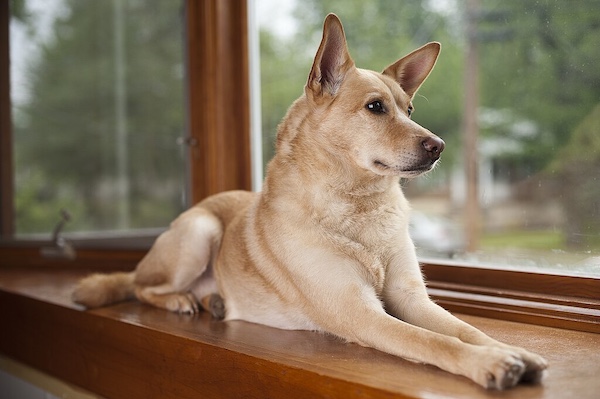
Image of ‘Sheila,’ a Carolina Dog by Thingsofbeauty and shared from Wikicomommons under the Creative Commons Attribution-Share Alike 4.0 license