
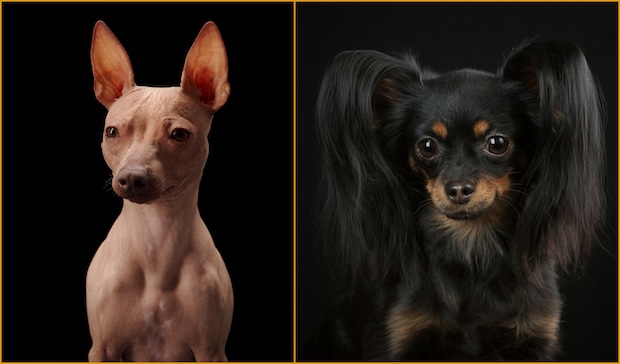
In 1972, a single hairless puppy born in a litter of Rat Terriers set the course for a new breed. Her name was “Josephine,” and through careful breeding by Willie and Edwin Scott, Josephine’s descendants established the American Hairless Terrier as a distinct breed.
Josephine’s hairlessness was caused by a naturally occurring recessive mutation at the SGK3 gene locus, which affects hair follicle development and maintenance; mutations in this gene lead to the absence of a normal coat in the American Hairless Terrier. Scientific studies showed that when two coated Rat Terriers who each carry one copy of this mutation are bred, about 25% of the resulting puppies will inherit two mutant alleles—resulting in complete hairlessness. This genetic trait had not been intentionally bred in Rat Terriers and emerged unexpectedly in Josephine.
Josephine was one of only two examples we know of in which a singleton was the catalyst for a new breed or variety.
In 1958, a unique puppy was born in Russia to two smooth-coated Russian Toys, one whose hair was a bit longer than the other. The youngster’s name was “Chikki,” and as he grew older, he developed “spectacular fringes” on his ears, neck and legs. Our sense is that at the time, Chikki’s unique appearance was met with a mix of curiosity and skepticism among Russian Toy breeders, but one breeder saw potential in Chikki’s long coat, and she began to selectively breed to establish a long-coated variety within the breed. Her name was Yevgeniya Fominichna Zharova, and her work established the long-coated Russian Toy as a recognized variety of the breed. She discovered, as is known now, that once this mutation appears, selective breeding can rapidly establish a new long-haired variety or breed if the trait is perpetuated. Chikki was bred to “Irma,” a female with longer hair than normal, and together they had three long haired puppies. By 1966, Zharova succeeded in establishing the long-coated variety leading to its eventual recognition by the Fédération Cynologique Internationale (FCI) in 2006. You can read more about this remarkable woman in a 2013 article in Canine Chronicle by the terrific dog writer, Ria Hörter.
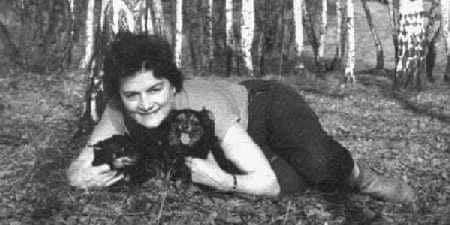
We found no scientific publication documenting genome sequencing of Chikki himself, but the most likely and widely accepted scientific explanation for the ear fringe and feathering seen in Chikki seems to be a spontaneous mutation in the fibroblast growth factor-5 (FGF5) gene that controls hair length in dogs and is responsible for the development of long, feathered, or “fringed” coats in many breeds. Subsequent studies confirm that the mutation in FGF5 is the most probable cause of the dramatic hair change seen in Chikki and explain why such a trait could suddenly arise in a single, unexpected puppy.
Josephine and Chikki both acquired their unique, breed-defining traits from rare, spontaneous recessive genetic mutations carried unseen by their parents. In Josephine’s case, a recessive mutation in the FOXI3 gene caused hairlessness, only expressed when both parents—though coated—passed down the mutated gene, resulting in a hairless puppy when two copies were inherited. For Chikki, the long coat and dramatic feathering were caused by a recessive mutation in the FGF5 gene, again emerging only when both carrier parents contributed the variant. Born to parents with normal coats, both became the first to display strikingly different traits through homozygosity for these mutations, allowing their new appearances to be fixed as breed characteristics by selective breeding. Although the specific mutated genes differ, the fundamental genetic mechanism—unexpected expression of a recessive mutation in a single puppy—was the same for both.
**In genetics and animal breeding, a sport is an individual that displays a new, unexpected mutation not seen in its parents or littermates. It’s historically used for plants, livestock, and occasionally dogs to describe exactly this kind of spontaneous phenotypic outlier.
Our two photos are not of Josephine or Chikki. The American Hairless Terrier is by Anna-av/iStock, the Russian Toy via DepositPhoto
the SGK3 gene affects hair follicle development and maintenance, and mutations in this gene lead to the absence of a normal coat in the American Hairless Terrier.